From Pillars of Eternity to Pentiment | Josh Sawyer (Obsidian) PART 2
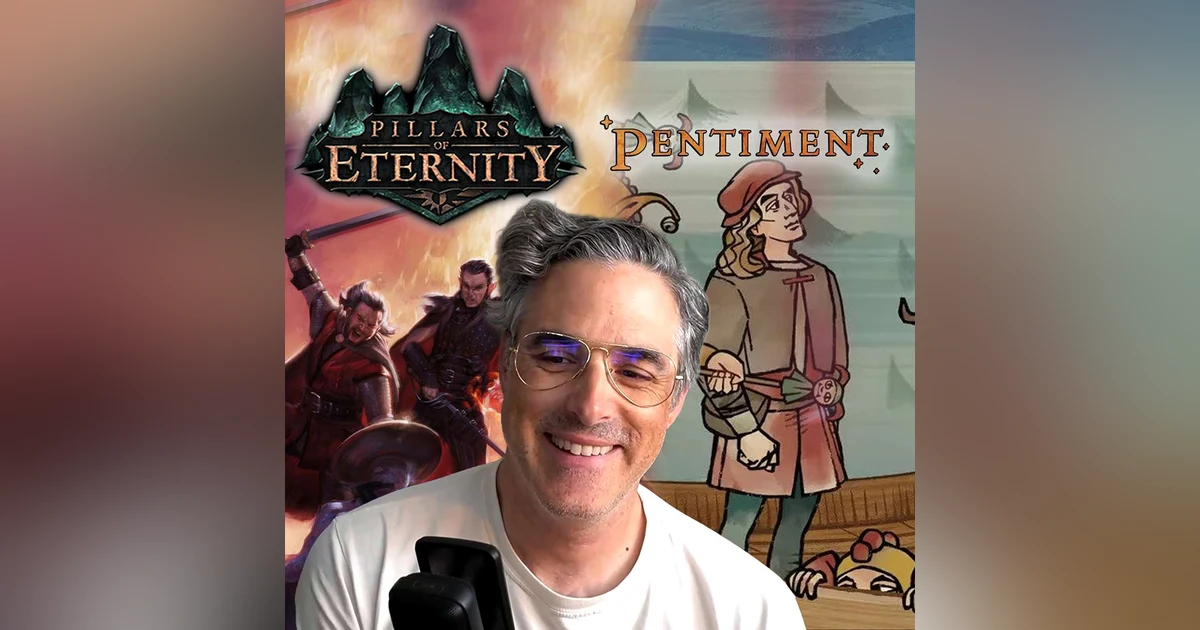
Send us Fan Mail This is Part 2 of my two part interview with Obsidian's Josh Sawyer. The first episode can be found here: WATCH HERE: https://www.youtube.com/watch?v=_HDXqBgMxy0&t=1448s LISTEN HERE: https://www.theexaminedgame.com/from-icewind-dale-to-fallout-new-vegas-josh-sawyer-obsidian-part-1/ In today's episode we dive into Pillars of Eternity, Pillars of Eternity II: Deadfire and Pentiment, what it took to get Pentiment made, and the act of defiance that came from making a g...


This is Part 2 of my two part interview with Obsidian's Josh Sawyer. The first episode can be found here:
WATCH HERE: https://www.youtube.com/watch?v=_HDXqBgMxy0&t=1448s
LISTEN HERE: https://www.theexaminedgame.com/from-icewind-dale-to-fallout-new-vegas-josh-sawyer-obsidian-part-1/
In today's episode we dive into Pillars of Eternity, Pillars of Eternity II: Deadfire and Pentiment, what it took to get Pentiment made, and the act of defiance that came from making a game that does not allow the player to become all powerful, but instead asks them to make mistakes and live with the consequences of their actions within a role playing game. Josh talks about the lessons he learned from not giving players the ability to kill Eothas in Pillars of Eternity II: Deadfire, the fact that this almost certainly frustrated much of the player base, and his insistence that it's important to limit the influence a player can have on the world they inhabit.
We also talk about the portrayal of grief in video games, and how he went about achieving this in Pentiment.
I'm really excited to bring this second part of my interview with Josh to you. The first interview, where we discussed Fallout: New Vegas and Icewind Dale, had such a strong response and I loved the engagement from you all. Enjoy!
#pentiment #obsidian #falloutnewvegas #pillarsofeternity #gamingpodcast #rpg
The Examined Game
Each week, host Steven Lake asks the creators behind some of the world’s most influential video games about the meaning of life (in video games), leading to conversations about the personal and creative impact games have had on their lives.
00:00 - Why You Can't Save Everyone
00:30 - Introduction
01:21 - Making Pentiment Feel Emotional
03:46 - Building a Living Community
09:03 - The Origins of Pentiment
11:15 - Why Murder Mysteries Don't Work in RPGs
15:55 - Making Players Live With Their Decisions
17:40 - "Just Do Your Best"
18:25 - Why You Can't Kill Eothas in Deadfire
20:21 - Superman and the Limits of Power
21:31 - Greater Powers in Pentiment
24:35 - "You're Enough"
26:02 - What Deadfire Taught Josh Sawyer
31:30 - Portraying Grief in Pentiment
Why You Can't Save Everyone
SPEAKER_00I save everyone. I kill everyone. I don't think that's particularly interesting. I don't think it makes players interrogate their values, either their own or like the character that they're playing. And so I always prefer to kind of create scenarios where it says like, you're gonna do your best, and your best is worth trying to do, but it's not gonna fix everything. Because you just can't, no person can't fix everything.
Introduction
SPEAKER_01There, my name is Stephen Lake, and welcome to the Examine Game. This is part two of the Josh Sawyer from Obsidian interview. And as I said in part one, if you missed it, I'd suggest go back and listen to it. It's very much about his history and getting into gaming and his you know early work with um Ice Wind and then going on to Fallout New Vegas. Today we're going to be talking Pillars of Eternity and Pentiment. Um, there's a few spoilers in here around the game if you haven't played it yet. It's such a brilliant game, it sets you up as a player in a way where you have to understand how finite the impact is that you can have on the world around you. You're trying to solve a murder and you're dealing with uh, you know, unreliable witnesses and unreliable information, and all you can do is, as he says it, which I loved, is as a player, try your best. And I think that's all we're trying to do. I love this conversation. I hope you enjoy it. Thank you very much.
Making Pentiment Feel Emotional
SPEAKER_00I will say, like, with Pentiment, I had a pretty clear idea of who the audience was, and there was a much greater focus on because Pentiment had almost no mechanics. It was the I was like sort of, you know, there's no mechanics, it's just talking, it's conversations and mini-games and cutscenes. And so because all of my attention was really focused on just the experience and nothing abstract, there was nothing mechanical really up here. It was all like what's on the screen in the moment. And I could tell when we were working on that that it was working, that we were, you know, kind of getting these funny moments across, these emotional moments across, that it was building a sense of community and connection, not only within the town of Tassing, but between Andreas and everyone around him. Um and yeah, there were like certain moments where, you know, we kind of ramp it up and we we focus in and really try to give a lot of attention to a specific emotional moment. And as we were able to do that, especially as we added music in, I was like, we're doing it. It's happening. Um and, you know, because I had not worked in that sort of format before with that kind of focus, uh, I wasn't necessarily immediately confident. But once we started doing a few scenes that felt like they were really working well, like um in our prototype, we had the scene where it was actually Brother Ghee was found dead in the chapter house. And I can't remember what music, I think it was like maybe from the Name of the Rose soundtrack that we pulled in and we scored it and we had everyone react and the conversation, and it felt like a big dramatic, like I was like, oh, okay, so we can kind of stage and block this almost like a play because you're just viewing everything from the side and everything. It's like it's like a rake stage going up and putting everyone on it. Um and yeah, it made me believe, like, oh, okay, like we we can kind of craft these experiences that players can get drawn into. Uh, they still feel like they're a part of them, they're making choices, they're making decisions and branching the story, but we can kind of craft the experience around it.
Building a Living Community
SPEAKER_01You should that's true. You just sort of made me realize, I think, in a way, like thinking about Pentiment, you know, you talk about the idea of the stage, and you have some quite big ensemble scenes, right? Yeah. And I guess actually, if I'm thinking about comparing it to like other games, it's like at least as far as I remember, you know, you are you're sort of getting, you know, especially when like something's discovered, or you know, some of the bigger moments in the game, you're getting quite a few townsfolk sort of talking about. There are some where we had like 20 or 30 people. Yeah, which is like obviously, you know, say like if you're playing a you know, first person RPG, you might be you know, be like a dozen in a room with three or something. Yeah, yeah.
SPEAKER_00Yeah, it's pretty rare that you see more than a couple. But yeah, we had like, you know, when I obviously when you find bodies, often there's a lot of people. But the fet, you know, like the the uh the Christmas feast, there's like almost the entire town is there. Yeah, um the summer, the uh St. John's Eve festival, you have like 20, maybe 30 people there. So yeah, and it was really important to have those communal, because community was such a huge focus for the game. And so it was very important that we have everyone there that we could. Um also, you know, one of the points of inspiration that I had for Pentiment was the Bruegel the Elder painting the procession, the procession to Calvary, which is a huge mannerist painting with like hundreds and hundreds of people in it. And there's a um book and a film called The Mill and the Cross. And in the in the film version, Rucker Hauer plays Bruegel the Elder, and he says, My painting needs to be big enough to hold everyone, everything. And I kept thinking about that as we were making the game because I was like, we not only does the game have to sort of contain all of society, from like outcasts, out like even below peasants, outcasts, peasants, you know, uh printers, bread makers, um, physicians, nobility, monks, nuns, um, executioners, like everybody, foreigners, like people who are not from the area who travel through. So I was like, the game has to show all of their lives and how they fit in together. But then also like I want to actually show them together. They need to come together in a scene where we see them all like this is the community, this is everyone.
SPEAKER_01It's interesting when you list those names off because as you were doing it, I could remember and picture every single one of those, you know, you know, some of the different individuals that represent those different groups. And I think it's a testament to the game that obviously, you know, a lot of the time when you're dealing with with characters, you sort of like, you know, you you're always confused about who that person was or misremember that, and and it can have it's got nothing to do with how many thousands of lines of dialogue they might have that's going to determine whether you uh remember them or feel engaged with them. Um and I think with Pentium, it felt like there wasn't there wasn't like a mechanic of an ecosystem in that game, but the way that the characters are written, it it sort of felt did feel like there was one. Does that make sense?
SPEAKER_00I think yes. Um uh the writers did a fantastic job in defining the characters. Um, also Hannah Kennedy and Sujin Peck uh designed the look of all the characters and made them all very distinctive and memorable. And then I actually have to credit um, you know, our director of development, Justin Brich, when he was playing our prototype, he said, I can't keep all these characters straight. He's like, you keep referring to people in conversations, but I don't know who you're talking about. And so we put in the feature where whenever a character is referred to by name and they're not on screen, it gives you a highlight and you can press a button and it shows you a picture of them. So if people keep talking about brother Ference and or prior Ference, and you're like, I don't, you're like, who is that? And then you press and you're like, that guy, okay. So you have the ability to sort of like drill into your head with these little references of like, I'm talking about that guy. Um, but a lot of it came down to design. Like, we we Hannah and I talked a lot about making sure that everyone was very distinctive. This was especially important with the monks and the nuns because they all wear habits, you know, they're all they're all dressed in like robes, basically. So making them stand out from the beginning was really important. We actually looked at um Cartoon Saloon. Um, they're amazing, and they made uh the Secret of Kells. And we looked, we didn't go as exaggerated as they did, but their monks in Secret of Kells are really exaggerated. Like there's a guy who's like this tall, and there's a guy that's like this wide, and he's like just a huge guy. And um, but it helps, it helps you sort of really distinguish these characters very easily. So art played a big part in it. Obviously, the writers did amazing work. Um, and then yeah, that little that little reminder where you could press a button and be like, that guy?
SPEAKER_01Oh, yeah, okay. And
The Origins of Pentiment
SPEAKER_01you know, in in terms of my, you know, my again, I'm making an assumption here, but that you you would have had this game in the back of your mind for a little while. Um maybe maybe not, but I'm curious about what uh you know, where where what was the impetus? Was it coming from there's there's some design approaches I want to try here, or I want to base a game in this region, in this era? Um, you know, what was the sort of the the seed that that that started Pentium?
SPEAKER_00Um, I mean, I I go back to Darklands 1992 as a historical fantasy game, like role-playing game. And I always wanted to make a historical game. And I never really got a chance. Part of it is my boss was very skeptical of historical games. I think, like a lot of people, he didn't have a great experience with history as a school subject growing up. So he was kind of like assuming it was gonna be just kind of boring. Um, I was like, why don't you assume that I'm gonna do the cool stuff? Um, or as I like to say, everything cool that has ever happened in the world is history. Um so uh after we got acquired by Xbox, and they were looking for Game Pass kind of oriented games, and I had played Knight of the Woods, which I think is a fantastic game. I had talked a bit with my friend Scott Benson, who was one of the main artists on that game. And I really liked that style because it was very simple, but it could be very evocative. I knew from playing Knight in the Woods that you could have very strong emotional connections with characters even without VO, even with a kind of cartoony art style, which shouldn't have been surprising, but it inspired me to think about like, okay, maybe I could make a historical game that's not like a historical fantasy game or like a role-playing game with combat, but it's like a story-based exploration and talking game about a murder mystery. And I kind of thought about Albrecht Durer, famous artist, and thinking about like a character kind of inspired by him, who is kind of put in the position of being a detective, even though he has no business being a detective, and he's just kind of forced to.
Why Murder Mysteries Don't Work in RPGs
SPEAKER_00And I also thought about, you know, we had actually been pitched on a game by another studio to do code that was a uh sort of a murder mystery type game. And it just made me think about how I don't like murder mystery games, in part because there's like one answer that you come to the end of and you're kind of like, you figured it out. And if you don't figure it out, try again, try again. Okay, you figured it out. You got the answer. And I was like, well, the role-playing game, so much of what we excel at is making the players sort of sit and deal with their choices, which often feel very imperfect. That sense of agony where you're like, I have two things to do that are good and bad, and I gotta decide which is most important. And so this idea of um, I need to I need to accuse someone of murder, but I don't actually know, and I can't know. There is no way for me to know for certain who actually did this. And so you understand that this person is gonna die, and you have to pick someone, and so you kind of have to do your best. And again, it requires the player to interrogate their own values and say, like, is it most important to me that I condemn the person I think did it? Is it most important to me that I condemn the person that I dislike? Is it most important to me that I condemn the person that I think the town will miss the least? Or like, and it's not easy. And then when you actually see the execution, we wanted it to feel pretty realistic and not it's not a fun thing to see. And some of them are botched because executions were very often botched. It's like brother Ference won't stop moving. It takes three hits to kill him, and he's and he's terrified. And a lot of people hated Ference. And so Ference is statistically the person most likely that people most often condemn in act one. And because he's just like an unlikable guy. Yeah. And he's kind of an asshole to Andreas directly. And so a lot of people are like, yeah, just get rid of this guy. And he, but he's so terrified of dying. He's so like pathetic about it. And then when he dies, he dies so badly because the execution is botched. And so a lot of players are just like, you know, and I've seen let you know, like let's plays or people doing playthroughs on Twitch, and they're just like, I don't, I don't like that. They're like, I feel bad. They're like, I feel I don't, I wish I hadn't like done this. And they're just like, I don't know if there was a better decision to make here, but like, I didn't think it was gonna happen like this. And it's like, well, this is how it happened. And so it was kind of that idea of can we make the player essentially role play choosing someone to die? Which is awful, but it's kind of like, but it it made me think about um, you know, one of the one of the source source books that I read in preparation for this was a book called The Faithful Executioner by Joel F. Harrington. And it's about a 16th-century Bavarian executioner, and his family was forced into the profession of being executioners, which was considered to be one of the lowest positions, it was like an outcast type of position. And what happened was these guys tried to stage a rebellion, and there was no executioner. The, the, the conspirators were caught, but there was no official executioner there. And the, I can't remember if it was a baron or a duke, but he basically pointed at this guy and said, You are going to be the executioner. And the guy said, Please do not make me be an executioner. I am a woodsman, like I have like a respectable family. And he said, If you don't do it, you're gonna go on the block and I'm gonna pick the guy next to you. And so he was forced into this position where he literally had to become an executioner or die. But then from that point forward, his family was an executioner family. And so forcing the player into a situation where it's like, I know you don't want to pick someone to die, but you basically have to. Um, and you're gonna have to live with whoever you pick. Um, so that was kind of the thinking behind all of this is like, I want to make a historical game. I think this format of Night in the Woods is a very cool one to kind of in an inexpensive way be very evocative and have these cool stories that you can tell. And then the idea of putting the player in a situation where you have to be an incompetent detective and make like life or death decisions that you then have to live with.
Making Players Live With Their Decisions
SPEAKER_00I love that.
SPEAKER_01You know, I think about like in movies, I think, you know, it's like in Jurassic Park, there's the guy who like sits on the toilet and he like gets, you know, the dinosaur, like kind of thing. Like, and he's like kind of an an ass. Like he's like, he's not particularly nice. And I think it's like, but that's it. And it's interesting in in games and in movies, the the the level of unkindness that someone needs to be for us as an audience or a player to decide they're worthy of like horrific death is pretty is pretty low. Like they were rude to the protagonist. That's and so and so it's it's interesting, you know, that that the play has been put in the the position where like, you know, as we always do, we like gravitate to what feels most just, even if it's not, and then to and then to to to do that to them and have them witness the um you know the the painfully real sort of consequence of of of that decision.
SPEAKER_00And I think part of it also was um because it's a game that takes place over 25, 26 years, it was not just to see the immediate aftermath of your actions, but you know, seven years later you come back and like how has the town changed because of the choice that you made, which is something that in most role-playing games you don't get to see things play out over that period of time. And you usually move on, right? You you you you kind of drift into town, you know, you shoot your guns and you like say, you live, you die, and then you leave. And then you you like, you know, maybe you can come back or whatever, but you don't see the idea of like, well, how is it other than ending slides? You don't see how does this play out over two years, three years, ten years? What happens? So that was another sort of desire is like, can we tell a story over a longer period of time in a single place?
SPEAKER_01There's
"Just Do Your Best"
SPEAKER_01something that you said, I don't know why it resonated with me, but it's this idea of players like you do your best, you know, that like that you're not uh you're not given the tools to be able to like, you know, 100%, you know, this this this game, you know. There's no there's no perfect conclusion, you know, and a lot of games aren't, you know, well they may be made that way, but we don't approach them in that way because it's like I won't I won't like do my best, I want to do like perfection, you know. And and there's just something really I just love that phrasing, you know. It's it's like it's it's maybe a little it's like you're a player, you're gonna do your best, you're gonna make some mistakes, um, but it's okay. Just just try your hardest and we'll get through
Why You Can't Kill Eothas in Deadfire
SPEAKER_01this.
SPEAKER_00Well, and I and I think you know, some people, and I think I I've done this in a lot of the games I've worked on, um, to different levels of success or favorable or unfavorable reception by the audience. Like in Deadfire, notably, like, you can't stop at this. Like, he's just gonna do what he's gonna do. And he, you're kind of told that point blank. And we we also try to telegraph that he's like way beyond the ability to physically do anything to. Um, but players are very conditioned by a lot of RPGs to expect, like, yeah, but I'm I'm built different. Like, I'm I'm gonna be able to take this guy out. And um, and then you can't. And you can you can help sort of ameliorate damage and you can make a bunch of very important decisions uh that have truly huge impacts, but you can't stop him. And part of that idea was again going against this idea of I'm the protagonist, I can literally do anything. Um, but also within the world of Pillars of Eternity, the gods are really, really selfish, even when they're being altruistic and they're extremely stubborn, and they manipulate things at such a level that it it's it should be infuriating that they that they manipulate mortals so much. And kind of I was going for this idea of like, well, he does it to you too. Like you're a mortal, like you are immortal. You, even though you're the watcher of Cadnua and you're very powerful and you can do all these cool things, Athys is still, the gods are still not gonna listen to you. They're still gonna try to manipulate you, they're gonna threaten to kill you, to destroy your soul. Athys is going to talk very patronizingly towards you and then ignore you. Like he's gonna kind of do something that you want, but you can't stop him and you can't hurt him.
Superman and the Limits of Power
SPEAKER_00And it's uh like I think, I think back to um, and this is a very different sort of thing, but like uh back in the 80s, I remember there was a um, you know, there was a Superman comic, or maybe it wasn't Superman, but Superman was prominently featured in it. And it was Starving Children. And Lex Luther was there, and he was basically and Lex Luthor was holding like a dying, or not Lex Luthor, Superman is holding a dying child, starving. And Lex Luthor says on the cover, he's like, all your power, and there's nothing you can do to save them. It's like, yeah, because you fucking shoot lasers out of your eyes and you're bulletproof, and you're like, but like mass starvation is like not a thing that you like punch your way out of or laser eyes your way out of. And so many problems are just human problems. They're like, they're part of the reality of life and being a human being and living on this planet with other people right now. And even in a fantastic world, there are still going to be powers that are beyond you. There
Greater Powers in Pentiment
SPEAKER_00are things that you can't overwhelm. Like in Pentiment, the last, pretty much the last chapter of Act Two is called Wismaior, which means a greater power. And it's a legal, it's kind of a legal term. It's like an exception that's put in contracts that says like if this happens, if a greater power, a power that is beyond human ability to affect, comes to pass. All contracts are null. Like it doesn't matter. You can't do anything about this. And so Andreas is given this task to find the murderer. And he does. Or I mean, he can, right? He can accuse someone. He he investigates and time comes out and he goes and he says, like, I figured it out. Like, you don't burn down the abbey. Like, it's okay. We found a murderer. They'll come to justice. It's okay. But there is actually a greater power, which is this incredible anger that the peasants, especially Peter, feel. And Peter can't be satiated. There's nothing, they're so, he's so angry. They're all so angry. They burn down the mill. And then in the end, he burns down the abbey. He doesn't care. He's like, it doesn't matter. Like, and you can't, and there's nothing Andreas can do. It's a, it's, it is a greater power, a power. Rioting, by the way, war is considered to be a greater power. Um, forces of nature, God, are considered to be a greater power. And so there are things that are beyond anyone's ability, no matter how powerful. I mean, in Andreas' case, he's not very powerful at all. But also in the case of the Watcher of Cadnua, he can't thwart a god. It's literally like truly in that case, a greater power, God, a God himself is going to oppose you. Um, so it's kind of like you make the choices that you can and you deal with the limitations that are imposed on you. And there are limitations. There are just limitations to everything. There are realities to life, there are realities even to the supernatural world that we put in front of you that you can't overcome. And so you're going to make a choice that it's like, well, at least, at least I did this. At least I accomplished this. At least I saved this person. At least I protected this town. At least I did X, Y, and Z. And I accept that as being important and worth doing, even though I couldn't do all of this other stuff. And I feel like if role-playing isn't kind of about that, I think if it's reduced to like, I save everyone, I kill everyone, I don't think that's particularly interesting. I don't think it makes players interrogate their values, either their own or like the character that they're playing. And so I always prefer to kind of create scenarios where it says like, you're gonna do your best, and your best is worth trying to do, but it's not gonna fix everything because you just can't. No person can fix everything.
"You're Enough"
SPEAKER_01Yeah, I mean, I love that sentiment. And again, it it makes me think of something John, you know, had had said about that, you know, that this desire as players, all the games put us in this position to be the center of everything and to be able to fix everything, and this idea of like it's like it's okay if you can't do that, you're enough, you know. Yeah, you're you're enough. He literally says that and I was like, you know, we talk about The Last Express, you know, that that sort of game from back in the night, you know, just like and how in that game, you know, time is relentless, like everything's gonna happen whether you like it or not. Um and just I just do you think that there's uh you know, again, with with with Pentiment, you you having to do a little work to sort of train a player that that is sort of what's gonna happen. Yes. Because because you know, it doesn't matter how worldly you are and your your approach to gaming or or what you play, like we have a pretty linear idea of like the way I'm gonna interact with the world and the way it's gonna push back to me, um, and how you made it work so that when that in some ways uh unsatisfying uh conclusion comes, that it can still be satisfying, just not in the way that one would expect.
SPEAKER_00Yeah, it's um
What Deadfire Taught Josh Sawyer
SPEAKER_00I mean, and this, you know, again, I I feel like I did learn a lot from Deadfire because players did not like that ending. They did not like that ending, they did not like the buildup to it. Um, I mean, we did a lot of work to telegraph those things, but it felt to a lot of people like miss mixed messaging. Some of it is probably genre expectations. It's a fantasy role-playing game. Of course I can kill a god. Um, so in Pentiment, I tried to make clear pretty early that the player understood that Andreas is a kind of smart guy, a talented guy, but he's also a very troubled guy. And he's not, he's very limited. He's a he's just a guy. Like this is this is a not supernatural world. You're not a superhero. You're an artist who had the benefit of a university education, which is rare for an artist to have. Um, so you have some knowledge, but also very early on, we telegraph to the player. Sometimes picking those options that get unlocked is bad. Like people get annoyed or irritated, it's not helpful. Um, and we have a lot of dialogue checks, and you fail a lot of them, and the story keeps going, it's okay. And so people started to kind of go like, oh, okay, like I'm kind of I kind of suck. Like I kind of am not like actually that good at anything. Um, and I'm not really well suited to be a detective. And at the end of the first act, you know, you do the best you can, but it doesn't feel heroic. Um, and so, you know, you're maybe three or four hours into the game, and you get to that point, you're like, well, I mean, I did it. You don't feel like Sherlock Holmes, you don't feel like William of Baskerville, even in Name of the Rose. You just feel like I I, you know, I did my best. I got through it, but geez. Um and then in the second act, you know, that gets ramped up, and also Andreas, you know, you start to learn that Andreas has all these, all this baggage from the last seven years that you were not privy to, but you start learning about his home life and how dissatisfied he is with his work and all these other things, and he's falling into this melancholia. And so you're you're like, God, this guy is like, he's really going through it. And then he's put in the situation where he has to do this work again. And so I think while some people are sort of shocked in some ways by the end of the second act, it wasn't, well, you know, everyone is different, but like most players were like, wow, that's like an amazing sort of end to that character arc because yeah, he really went through a lot and this was really hard. And I mean, it just kind of was beyond him, right? Like a whole town is rioting and there are soldiers coming in. How would you expect that an artist could could really like, you know, do anything to stop this violence from happening? Um, and so I think because of the difference in genre expectation and also how Andreas is characterized and how the mechanics worked and the storytelling worked up to that point, I think players took it a lot better. They were like, yeah, like that's rough, but like I I understand, like I get it.
SPEAKER_01The the way that you handled, you know, the you know, when we find out about the loss that happens in Andreas' family, you know. The I think uh if if I remember correctly, you're sort of moving around the the sort of top-down map that you go to whereby, you know. Yeah, yeah, the labyrinth. I just absolutely loved that, and it made me think of you know um Wolf Hall and Bring Up the Bodies as two of my sort of favourite books, you know, um you know, about um I forget his name to go. Thomas More. Thomas More, yeah, you know, and um there's there's this very simple chapter in that book that sort of covers the the loss of his his his daughters, you know. And um that to me was and it was it's it's a it's it's super simple. It doesn't like draw out or anything, but it's an absolute sort of gut punch. And I think I just love that moment in that game because I think grief, uh loss, you know, followed by grief in games is a hard thing to sort of get right. And I think the temptation is usually to sort of overag it, um, but to sort of hold back, um, and everything that you've learned about him and his relationships up to that point, there was it was a really beautiful moment where I felt like everything that had been going on in that game, it did it it got me exactly the way I think you expected it to get me, if that makes sense.
SPEAKER_00Yeah, thank you. It was um it took us a long time to sort of arrive at that point. Um, because I knew that I wanted Andreas to have problems in the second act and be kind of like emotionally distant and disaffected. And and um, you know, the more I went on, the more I was like, I feel like this doesn't feel genuine. I don't really understand because we hadn't defined exactly what he had gone through. And the more we started working in act two, um, you know, I remember having a conversation with Kate Dollarhyde. Um, and I was like, I feel like, I feel like he like maybe he lost a child. And this was like something that had come up already because we had other characters in the world losing children. I mean, infant mortality was like almost 50% at this time, which is unbelievable. Um so I was like, it's very possible this could have happened. And but I was like, I don't, I feel
Portraying Grief in Pentiment
SPEAKER_00like he would just want to not talk about it. Like, who would want to bring that up? And like certainly not as an excuse, because then it just opens up this door to all these other questions. And and so when you first arrive in Tassing, and he, you know, he doesn't want to go home, right? It's like, and so it adds another layer to like, I don't want to confront my wife, who, you know, we keep going through this, it's not getting better, it's just getting worse. I want to avoid going home. I want to go back to a place where I remember feeling some sort of satisfaction and pride, brother Piero, but he he died. Um and then he encounters all these people who say, like, we wrote to you, like we like why why didn't why didn't you write back? Why didn't you come back? And he just can't like he just can't deal with it, he can't bring it up. Um because it just it would be too hard to like deal with all that. And so he just kind of takes it, right? He just kind of goes, like, I don't know, like I'm sorry. And then in his mind, the only voice that's there, you know, I I said, like, I think that the only voice left in his mind is melancholia, you know, it's sort of a transformed Beatrice who's, you know, kind of turned into this, it's just doubt. And she's kind of like needling at him. And so if you pick those thought bubbles, she's just like, Why don't you want to talk about it? Like, why don't like why don't you just say it? And he's just like, please shut up, and she won't. And so anytime he goes into his thoughts, the only thing that is there is this like this regret and this kind of like melancholy. And so it's better if he just kind of says, like, yeah, I yeah, sorry, I didn't. And he just deflects, he deflects, he deflects, he deflects. And so it's not until he sleeps where he can't escape it. Because all he has is his own mind. And in the first, in the first act, the ideal city, that's based on a layout of like a Renaissance ideal city where like there are all these avenues in. It kind of, I think to players, they might feel like, why am I why am I made to traverse this when it's so easy to get in and out? Yeah. And it's because it's it's an ideal city, it's a renaissance layout that is designed from a perspective of like, we have designed this world to be laid out perfectly, so it's super easy to get everywhere you need from anywhere. It's ideal. And then when you play in the second act, it's a labyrinth. And so a labyrinth, there is only one way to go, and it's the longest way to go because it's the entire distance of the thing, and you have to do it every time you go in and out. And so it has shifted from the ideal city and ease to like every night I have to come in this way, and I have to go this way, and I have to go past this, and I see my wife, and I have to go past this, and I see my son. And then the sender, all I find is melancholia. There's no one else to advise me, there's no one else to comfort me. It's just loss and regret and and depression, basically. Um, and then in the third act, it's a maze, it's an actual shifting maze. So it's like it's uh because his brain is disordered, it's like it's completely beyond sort of like it's it's it's sort of protecting him from escaping this mode that he's locked in. So it was this intention to like reflect the state of his mind through how you have to move through it. But labyrinths were used for meditation. You know, that's what they were used for in medieval churches. Like you would walk not a not a you know huge labyrinth, but like a labyrinth on a floor, you would walk the path of the labyrinth and pray or meditate as you went through. And so it became this kind of calming, centering practice. But for Andreas, it's this like it's this inexorable pull towards these things that he doesn't want to deal with in his waking life.
SPEAKER_01Um that's a feels like a perfect blending of of the mechanic meeting, you know, story and tried to keep it simple character. Yeah, yeah, yeah. I guess okay, just for so very finely come way back to something you said. You said you you pictured the audience you had for this game. Um, and I guess I'm curious like like who that was. Did you did you reach them? And you know, in casting the the the net out of this game, I'm assuming you probably reached people who would have bounced off of it, right?
SPEAKER_00Um Yeah, I um it was it was oriented towards people who like gamers who like adventure games, they like narrative games, but a big portion of the audience is people who like people who are not gamers, but who like history, they like art, they like murder mysteries. Um it was and it was so it was like non-gamers in a wide age range who are interested in this subject matter. And I got them. Because like they're not necessarily served that, you know, well. Because the thing is, like, and a lot of times when it's sort of like here's a game of simple mechanics, the the idea is, well, this is for children, right? This is for people who are not mechanically like they're not dexterous or they're not, they don't have the literacy, the game literacy to play this. I was targeting adults. I was targeting people like my age or even older who don't play games, so people who are like maybe 50 years old or 60 or whatever, but like the mechanical requirements of the game are extremely simple. And so it's if you like reading, because there's no VO, if you like reading, if you if you like just kind of like exploring, you like history, you like art, that's kind of who it was for. And which is not, you know, it's not Call of Duty, but also it was a small team, and so and it was for Game Pass. And so we weren't really trying to find, you know, make a blockbuster. We were trying to make something that was for people who just wanted an experience that they couldn't find necessarily in a lot of other places, and so yeah, so we we found a lot of people that are super into history history and illuminated manuscripts and and books and reading and things like that and murder mysteries. And and uh yeah, they showed up.