From Icewind Dale to Fallout: New Vegas | Josh Sawyer (Obsidian) PART 1
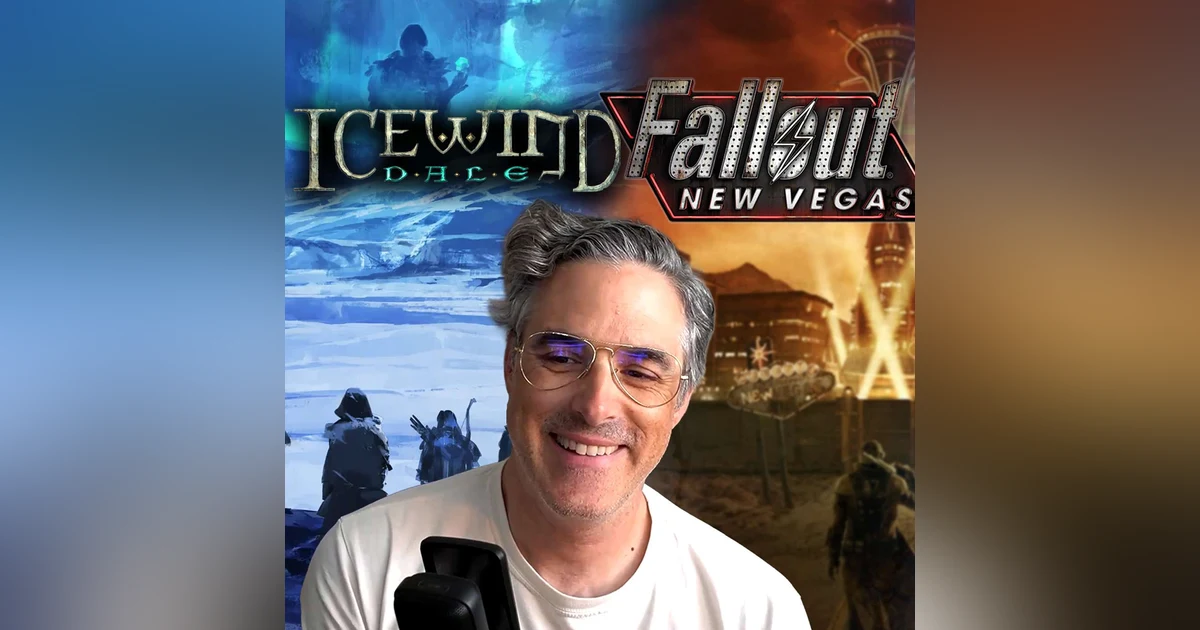
Send us Fan Mail Today on The Examined Game, I’m joined by Josh Sawyer (Joshua Sawyer) Studio Design Director at Obsidian Entertainment. Josh is an industry veteran whose credits include Icewind Dale, Fallout: New Vegas, Pillars of Eternity II: Deadfire, The Outer Worlds, Pentiment, and many more. So what do you talk about with someone who has worked on so many beloved RPGs? We discuss how games can convey grief, the joy and frustration of not letting players kill God, his beginnings as a web...


Today on The Examined Game, I’m joined by Josh Sawyer (Joshua Sawyer) Studio Design Director at Obsidian Entertainment.
Josh is an industry veteran whose credits include Icewind Dale, Fallout: New Vegas, Pillars of Eternity II: Deadfire, The Outer Worlds, Pentiment, and many more.
So what do you talk about with someone who has worked on so many beloved RPGs? We discuss how games can convey grief, the joy and frustration of not letting players kill God, his beginnings as a web designer breaking into the games industry, how the Fallout: New Vegas team compensated for severe time and budget constraints through exceptional story, characters and world-building, and the risks he took to bring Pentiment to life. An extraordinary RPG set in 16th Century Bavaria.
This is Part One of a two-part interview, covering Josh’s career from his early days in the industry through Fallout: New Vegas.
Part Two, releasing next week, is dedicated almost entirely to Pentiment, one of my favourite games of the last few years.
The Examined Game
Each week, host Steven Lake asks the creators behind some of the world’s most influential video games about the meaning of life (in video games), leading to conversations about the personal and creative impact games have had on their lives.
00:00 - How Fallout: New Vegas Was Made in 18 Months
00:30 - Introduction
01:16 - What Josh Sawyer Is Playing Right Now
02:50 - From Pong to Bard's Tale
05:30 - Discovering D&D and RPGs
06:43 - Wanting to Be an Illustrator
08:01 - Music, History, and Finding a Direction
08:46 - Designing Tabletop RPGs as a Teenager
09:56 - Becoming a Web Designer at Black Isle Studios
10:36 - From Website Designer to Game Designer
11:19 - Finding His Path in the Games Industry
15:38 - Designing His First Dungeon in Icewind Dale
16:59 - Learning the Importance of Pacing
19:57 - Why RPG Dungeons Used to Be So Massive
23:06 - Becoming Lead Designer at 24
24:29 - The Black Hound: The RPG That Never Released
26:13 - Making Icewind Dale II in Just 10 Months
28:23 - Fallout: Van Buren and Watching Black Isle Collapse
31:36 - Getting the Chance to Make Fallout: New Vegas
34:17 - The Core Design Goals of New Vegas
35:10 - Why New Vegas Focused on Content Over Technology
36:04 - Building Meaningful Choices and Factions
41:46 - Josh Sawyer's Favourite New Vegas Ending
44:32 - Why Great Writing Beats More Features
46:06 - Why Fallout: New Vegas Wasn't Universally Loved at Launch
How Fallout: New Vegas Was Made in 18 Months
SPEAKER_01So we knew that we had a very short development cycle. We knew that we had technology we were unfamiliar with, and we had very few programmers. We can't afford to like experiment. And so I said we really have to lean into what we do very well. Content that makes your like really makes role-playing shine. It makes your character build choices feel very important and significant. It makes your ethical and moral decisions feel important and difficult.
Introduction
SPEAKER_02Hi there, my name is Stephen Lake, and welcome to the Examined Game. Today I am talking with Josh Sawyer from Obsidian. This is so I've made a decision to break this up into two parts because it was such a big, dense conversation. We start off with part one, which you're going to hear today, you're going to watch today, and that's basically about, you know, his interest in all things gaming, DD. You know, this is a person with the likes of Pillars of Eternity and Icewind and Fallout New Vegas and Penton, you know, um, under his belt in terms of games that he's been heavily, heavily involved with. So there's a lot to talk about. So yeah, part one is very much about his sort of build-up to getting into gaming and then those early projects, and we kind of end on Fallout New Vegas, which you know makes up for a big chunk of this interview. And then part two is going to be pretty much solely focused on Pentiment.
What Josh Sawyer Is Playing Right Now
SPEAKER_02Thank you very much. You know, I think when I wrote you, it was it was sort of specifically about these moments when you, you know, obviously it's kind of important in a game that you capture the player and all of the work that has to go on to sort of pull that off. Um, but before we sort of get into that, I usually just like to build get a little bit of context on people. And I'm always interested in what some what people are playing, like present tense, if there's anything that you're um playing right now.
SPEAKER_01Playing my game.
unknownOkay.
SPEAKER_01Um trying to think if there's anything else that I've uh yeah, unfortunately I fell off. Um I was the problem was I was playing Arc Raiders, and I was getting ready to play First Light, and then I had a partition on my home computer died. And so I had to restore from an old partition. And then after I did that, I was having video card problems. And then I just haven't, like I only recently kind of got everything back together. So I haven't been really playing very much, unfortunately.
SPEAKER_02Okay. So you've been in like yeah, there's there's a lot of words that as a as not a huge PC gamer anymore that I don't have to hear so much like partition for it.
SPEAKER_01Well, the the big fear for me with hardware prices being what they were is that something was actually like destroyed physically. Um thankfully that wasn't the case, but I did lose a bunch of data and I thought my video card was fried. But it's all it's all good, but I have yet to like get back into playing anything, unfortunately.
From Pong to Bard's Tale
SPEAKER_02Yeah. And then and then what I'm usually interested in, like what and it's not always video games, but I I just like to get a sense of what people's like, you know, what's your like earliest version of of play, you know, be it gaming or books or DD or whatever, the thing that you could sort of draw a line between what you were doing way back then, which is usually, you know, people's childhood, right up to what you're you're doing now.
SPEAKER_01I mean, the first thing I can remember playing, um, my brother, he's about eight years older than me. And we got we couldn't get Pong, but there was a knockoff. There's an American company called Radio Shack, and they had a knockoff that's sort of like great value uh Pong. I can't remember what it was called, but it looked like Pong and it pretty much played like Pong, but it was sort of the less expensive version of that. So you'd still, you know, you'd hook it up to your TV, and you had a main controller and then a secondary controller, so my brother and I would play that. And then my brother got an Atari 2600, and he played it a little bit, but I wound up playing it a lot more. And I think the first game that I remember really getting into was Adventure on the Atari 2600, which is the one that has the duck dragons, the little colored duck dragons. And I loved Adventure, and I actually beat it, and I played it over and over and over again. I played Pitfall and all those sort of games. And my brother was never really as into video games, but I I really enjoyed the 2600. And then I had friends around me who had Tandys and Commodores, and a couple of them had IBM PCs, which weren't really very good gaming machines back in the day because they were they were like EGA or CGA graphics, pretty limited. Um, but the game I really remember getting me super into gaming was uh I saw a kid at our local library. We had a public library that you could you could basically check out a computer, and they had an Apple IIe. And I remember playing like Oregon Trail and a bunch of other games on that, but there was a Commodore 64, and this had to have been early 80s, and I saw an older boy, Tony Unati, playing Bard's Tale 1. And Bard's Tale 1 on the Commodore 64 looked amazing compared to anything on the Apple IIE because it was full color and it had uh the audio was actually quite good on the Commodore 64 compared to PCs and apples. So I was like blown away. I just couldn't believe it. And
Discovering D&D and RPGs
SPEAKER_01it was around the same time that I was playing basic DD with some friends that were my age. And so then I just threw computer role-playing games like Bard's Tale, later the fantasy series, Wizardry, Ultima, uh, and then I started playing ADD and other tabletop role-playing games. And that's that was really like my childhood. I got really, really into those and it never it never let up.
SPEAKER_02That's a good that's a good lineage from knockoff pong through to um uh to that. I I it's interesting about knockoff pong, because I sort of you know, it makes me think, you know, if you buy like a knockoff controller or something and you know the stick just doesn't quite the same, but uh when it's a pong were not super high. So that's what I'm wondering. You know, did it you know, would you have would you have felt the difference in resistance on the paddle or you know, I wouldn't have known any different. I'm guessing that's not like, oh, and that's the moment that you started to like, you know, but head towards working in like, you know, video games. Like I'm I'm interested in in what else was running parallel to that. Like what did you go on to like, you know, if you studied something, what were your interests, and and I'm assuming there may be some interweaving
Wanting to Be an Illustrator
SPEAKER_02down the line.
SPEAKER_01I uh I wanted to be an illustrator for most of my childhood and going into young adulthood. My father is a, or he's retired now, but he is a bronze sculptor. And, you know, he also did some illustration and a lot of drawing as the foundation of his sculptures. And I really love fantasy illustration. Um, and I got a lot of that interest from from playing role-playing games. So I started learning to draw, and I took every art class that I could, and I went to art summer camp and all this other stuff. And I mean, for a kid in a Midwestern town, I was pretty good. Um and I was getting ready to go to me uh to art school, and then in high school, things kind of changed. Um, first of all, I had to start doing painting, and I'm colorblind, and skin tones were very, very difficult and frustrating. And so that process got uh very difficult because I loved illustrating characters. Skin tones were very hard for me to work through. And to be honest, um there were some teacher issues that that didn't go as well as they had earlier. And so I started moving away from art and I got into music, which I had
Music, History, and Finding a Direction
SPEAKER_01also gotten into through my dad, because my dad was a musician and he always played music every day at home, and I would sing with him. And so I started doing musical theater and choir and soul and ensemble, and then I went to school for musical performance, which is not having anything to do with um video games, really. And that was really hard because the thing is, I loved singing, but I never learned theory and I never learned any keyboard skills or anything. So the music program at Lawrence University was very hard, and I was a very lazy student. So I transferred out of the conservatory into the college, and uh I got really into history. And
Designing Tabletop RPGs as a Teenager
SPEAKER_01throughout all of this, I was still playing role-playing games, and I had started making my own role-playing games, tabletop role-playing games, of course, not video games, but um, I just did it because it was fun and I would make games for my friends. When we would play tabletop role-playing games, a lot of times I didn't like how the rules worked. And so I was like, this is stupid. And so I would just change them. And then at a certain point, I was like, well, I can just I can just make my own rule set. Why am I why am I bothering using someone else's rules? So I did that. And I kind of figured that I would always wind up making my own games. I didn't really understand that it was a an occupation, like uh tabletop or video game. Like, obviously, that makes sense, but to uh like an 18-year-old, 19, 20-year-old, I didn't actually understand how any of this stuff worked. So I was making my own tabletop games, and I didn't think that this that was necessarily going to be my profession, but that's what I was just kind of doing. And when I graduated in 1999, or I was about to graduate,
Becoming a Web Designer at Black Isle Studios
SPEAKER_01and I wasn't really sure what I was gonna do. I taught myself web design. I did, because it was the mid-90s or late 90s at that point. I taught myself flash animation, and I wound up getting a job at Black Isle Studios, which is crazy, um, as a web designer. And uh they were working on Planescape Torment.
SPEAKER_02So my first that was your official first role in the industry web designer.
SPEAKER_01I got uh I got a job working for Black Isle Studios as a web webmaster, web designer, and I designed the website for Planescape Torment, and I also was designing the website for Icewindale one, which
From Website Designer to Game Designer
SPEAKER_01I wound up, excuse me, becoming a junior game designer on. Because once I actually got to Black Isle, I realized, oh, this is this is how game development works. Because I was working with the team, and I was like, oh, okay, so there's like a team of designers and there's a team of artists, and there's a team of animators and a team of audio people, and it like this is a whole group of people, and I could be one of those people maybe. And it just so happened that I went to work for a company where um, you know, they focused on role-playing games, and so it was just extreme luck.
SPEAKER_02Can I ask, you know, you you're going between those different things, you know, you're from from um you know,
Finding His Path in the Games Industry
SPEAKER_02where you obviously land in history and then doing the web science stuff. You know, and this is an interesting question because it, you know, if I was asked this, I'd probably say, well, I don't know that I have yet. But there's this idea of like at what point we feel like we're actually in the groove and we're on a path, you know. Um I I just wonder if there was a you know, when you were sort of trying to find your footing about you know what where you wanted to put your attention, was there a sort of a feeling of being slightly like um, you know, uh not in a groove with what you wanted to to do, and then sort of hitting your stride, if that makes sense.
SPEAKER_01Um no, uh it's it's maybe because I was young, I felt each time that I committed to a new thing, I felt like this is it. Even even if there was no real um I've never really been very good about long-term planning or thinking. I I kind of think about stuff about a year and a half in advance. And anything past that is I feel like it's so far out of my control that I don't really think about it very much. So when I wanted to do illustration, I just focused on illustration. And then when I was like, this isn't working, I was like, I'm gonna do music, I'm gonna be a musical theater performer. That's it. I'm gonna do musical theater professionally. And I mean, I had there's a dinner theater in my hometown. I had done that. I worked in a Shakespearean acting company for a summer, and I was like, yeah, of course, I'm just gonna do this. This is gonna be my life, I guess. Um, I didn't really think about it that hard. I was like, this is what I'm doing, feels good. And then when I started doing history, I loved actually studying history. I didn't know what I was gonna do, and I didn't have really a plan about what I was gonna do, but I was like, yeah, of course, I'm just gonna do this. And web design was something I sort of picked up that was fun. I sort of thought it was neat. I thought web websites were interesting, I thought flash animation was interesting. And then when I got a job as a web designer, I had done it professionally as a freelancer before. Um, and I had worked for ISPs back when we had those, um, doing web design work. So I did that, but then when I got the opportunity to do game design, at that point, then I just kind of like locked in on it. But I didn't have a feeling of it wasn't like I was uncertain at any point. I just because I wasn't thinking about it. I was I was just like, yeah, this is cool. Like, I'll keep doing this. Yeah, let's keep going. Um, and then video I've been doing video games for 27 years now.
SPEAKER_02I did that, I was actually big into Flash, and then I did this like Flash Dreamweaver course when I was like 15, and it was me and a bunch of people that were like they were like in their 30s, but they seemed extremely old to me at that point. And they were all there because their companies had sent them to learn how to make a website for their company, and I was this kind of weird 15-year-old kid who who spent the summer learning Dreamweaver. Um I just hadn't thought about that for a while. That's gone.
SPEAKER_01Yeah, we use we use Dreamweaver for a while. I um when I started, it was all just you'd do it in notepad. Because it was just you just type the HTML directly in, and there was no parser or anything to tell if you had made an error, so you'd just save it and load it and go, it's not working, and then you'd go back in and find it.
SPEAKER_02Or remember that with you know, when you'd get a bit stuck on just doing it, you could so you could obviously hop back into the HTML as well, couldn't you? I I obviously I eventually just moved, I I I I got I was pretty rudimentary when it came to whatever my coding ability was, um, which is why I turned to filmmaking. But um, you know, and so then you know, I guess I'm interested in what for you were those earliest moments where you felt like you were contributing to a game and sort of, you know, again wanting to wanting to to work towards that moment are like, all right, what do we need to do here to make sure that the players can sort of get get caught caught by this? And well, and this is maybe a a follow-up question. There's I'm assuming there are times when you feel like you achieved that, and times where perhaps you feel like you you you didn't know you.
SPEAKER_01Didn't go very well.
Designing His First Dungeon in Icewind Dale
SPEAKER_01Yeah, yeah. Um, I mean Ice Windale 1, that was I was working with a team of people, and it was a small group of designers. Teams were not super large back then, even for kind of big projects. And each designer was kind of responsible just for their own stuff. And so I worked, I think the very first area I worked on was Creslac's tomb in Icewindale one. And it was a big dungeon. And um I remember I drew there's a photo of me somewhere. I have the maps still in another room here, but um, I drew them all out on like newsprint paper, like pretty big, like uh like th two by three foot newsprint. And I just drew the maps by hand and then I gave them to the artist, the 3D artist who's um uh Mike Presnell. Uh I'm sorry, I should back up Dennis Presnell, who uh still works for he works for Obsidian. Um, but he he translated my um my drawings on on newsprint paper into the dungeon. And the whole feeling with that was it was uh a crypt and it was supposed to be very labyrinthine and very narrow, and it was three levels. It was way too big. The thing is, like, I didn't
Learning the Importance of Pacing
SPEAKER_01have any sort of conception of pacing. It actually, I would say half my career I didn't have any conception of pacing. So I just I would look at things in a very like macro way. I would look at like, look at this map, look at this huge map and another huge map. And it was kind of like I wanted to, I was gonna ask.
SPEAKER_02So if yeah, if not pacing, what were you honing in on?
SPEAKER_01It was kind of like the the awe of the the size of the thing, you know, it's like building this massive, weird crypt, you know, three, I think it was a three-level crypt. And, you know, each one had like variations on like the previous level, sort of, and it had like secret doors and twists and turns. And thinking about experiencing it, like I was thinking about experiencing it in a tabletop sense, which is not the same as experiencing it when you're you know navigating at a weird isometric angle, you know, trying to navigate guys around. And it all built up to this at the end, you would confront Cresilak, who was the tomb that it was named after. And uh he was supposed to be a pretty terrifying figure. And geez, it's been so long, I can't remember. You did have a conversation with him. It's probably one of the first dialogues I wrote, um, where you you have a conversation with him because he doesn't necessarily attack you right away. And um the voice actor that I got to work with was Tony J, who that's an amazing first voice actor to work with. Um, if you go back and look at Tony J's credits, like he had such a um memorable voice, and he was in so many films as like just this really deep, incredible, booming voice. And um being able to work with him and have him be this super imposing, basically, not quite a death knight, but you know, that sort of a figure. Um, so that was the first thing I did is just that big dungeon that was all kind of like three levels of increasingly gnarly undead that that culminated with um.
SPEAKER_02It's a lot of that's true.
SPEAKER_01That's a lot of ice when Dale is like everything was like kind of too much.
SPEAKER_02It is interesting because you made me think about, you know, I think about the the I use the word tolerate, which sounds a bit negative, but you know, when I the the the games I was playing like in the 90s, you know, and the this the size of the levels, you know, that you're working your way through, and then when I go back to play those ones and I'm you know I'm surprised at how my you know ability to hold it, have it hold my attention has diminished because you know, often now in a game, and it's it's it's rightly or wrongly, you know, a a crypt is like you know, it's the entry point, you know, two little side areas and then the final thing, you know, um both great in their own ways. But uh yeah, tombs, crypts used to be a lot bigger back in the day, that's for sure.
Why RPG Dungeons Used to Be So Massive
SPEAKER_01Dungeons, dungeons in general could be you know, massive, even going forward 15-ish years to um Pillars of Eternity. You know, we made um the Endless Paths of Od Nua, and that was a 15-level mega dungeon. And a couple of those levels are kind of small, but like it's huge. It's really massive, and it was it was kind of built out as a challenge where I think it was uh for every for every so many likes or shares that we got on Facebook, we would add a level to the drawing of the of the of the mega dungeon. And in the end it was 15 levels, and and it was designed so that you could exit it easily and come back later. So players would like go down a few levels and it would it would increase the difficulty would increase faster than you would level up. So it was designed that if you went into it early, you'd kind of go down and then go, oh crap, and then you'd you'd you know, retreat and do some more and then come back and then go a little deeper and then leave and come back. And so throughout the game, you're kind of doing it in in chunks basically, until the the end of the endless paths was designed to actually be more challenging than the end of the game. So it's a really difficult uh dragon fight. People really got frustrated by it. Um, but it was designed to have that sort of like the experience was supposed to be each level is a new experience, so it was different from the previous one, like different endings and different sort of story to tell. Not necessarily a huge level, but big enough that it didn't feel like we were cheaping out on you. And then, but it was like this feeling of being overwhelmed and needing to leave, do some of the main story, then come back, because it's right under your castle. So you like keep going down, stop, be like, okay, I gotta go do something else. And when people cleared it, there's a it seems like a general like there's a big sense. Satisfaction because it is so exhaustive to go through. But I think it's the combination of kind of small levels stacked on top of each other, easy to exit, very easy to come back to, which compared to some of the dungeons I designed in Icewind Dale One, or any of us designed in Icewind Dale One, it's like a long time to get to it. And then you take, like, I think the worst example of this was Dragon Dragon's Eye, which is the second dungeon I designed for Icewindale 1. And that was five levels, and they're all pretty big, and there was no short cutout. So if you wanted to leave from any level, you had to backtrack the entire way. And then when you wanted to come back, you'd have to come all the way back to Dragonseye and go all the way down. And when you cleared it, there was still no short cutout. You'd have to walk your whole party all the way back. So yeah, dungeon design was uh in some ways it was cooler and better, but in other ways, like the convenience, because a lot of that walking was just kind of tedious and like Yeah, yeah.
SPEAKER_02All right. I guess you gain something and you lose something, you know? Yes,
Becoming Lead Designer at 24
SPEAKER_02absolutely. When you when you um make that more more efficient. And then so what for you do you you know, I'm sure that there's been many times where you feel like, okay, this is like a new plate that I'm having to step up step up to here. But uh I guess I'm just uh uh curious about you know your involvement with the the the games that you're working on, like um, you know, what what feels like to you like okay, this is like the next sort of big jump up in terms of you know, I'm guessing, you know, you're becoming more um you know, uh I don't want to use the word like senior in it, but you know, like overseeing things more and more and thus taking on a lot more responsibility. Um yeah, there are uh games where you feel like that was quite a big jump and there's it is almost intimidating what you were looking, you know, staring down the barrel of.
SPEAKER_01Um maybe you don't think that way. Um so in back back then, people could get promoted quite quickly. As an example, on Icewind Dale 2, I was a lead designer. So I went from being a junior designer to a lead designer. And web designer, junior designer, lead designer. That's the yeah, web designer over to junior game designer and then lead game designer. Um, so yeah, I moved right over to Icewindale 2. Actually, technically speaking, I moved over to be a lead
The Black Hound: The RPG That Never Released
SPEAKER_01on a project that was canceled, called FR, codenamed FR6. We also called it Jefferson internally or the Black Hound. Uh, it was a DD game, and again, I didn't really think very much about I was like, yeah, I could do that. Yeah, I could be the lead designer on a huge game with like 40 people on it. Why not? I'm 24 years old. Um so yeah, I just jumped into that because Icewindale one was a one-year product or 14-month project, and so then yeah, I started on on uh Blackhound FR6, and I wasn't intimidated by it, but I probably should have been. And I certainly only half knew what I was doing because I was working with technology at we we were making our technology from scratch, really. And whereas with Icemandale one, we were using BioWare's Infinity Engine, and that that was an engine we had already used, or we, the team, had used on Planescape Torment. So we had a level of familiarity, whereas, you know, I still didn't really fully understand how engines worked, how different engines worked. But I just dove in and I started doing it. And at first I didn't really have anyone under me. And I think that the pressure, it was actually pretty low pressure for a long time because we were just in pre-production and we kind of stayed in pre-production forever. I remember going back, I wrote, I wrote 1600 pages of design documentation, which is stupid. For who? Like there's no no one was on the project at that time. So we put it on pause, and I I switched over to Icewindale 2, and I stepped
Making Icewind Dale II in Just 10 Months
SPEAKER_01in as lead designer there, and there was a lot of pressure because we made that in 10 months. It was originally supposed to be made in four months, which is kind of unbelievable. But I said, like, we're we're not gonna be able to do that. Like we're we'll move as fast as we can, but we can't make a game in four months. So it's it then slipped to nine months, and then we finished it in 10 months and converted it to third edition DD. But I had a team of designers and I was sort of leading them. I don't think I was really leading them that well, in part because we didn't have time to review things. So uh people would submit design docs and I would look at them and I'd go, sure, or like maybe change this and like go, go, go, go, go. Because I was designing my own stuff. Everyone had so much work to do, and we were moving so quickly that there wasn't a ton of time for me to review things. And if I did review things, the iteration loops were very short. So unfortunately, most of those designers were kind of just working on their own. There's just no time to look at anything. Um, so I felt pressure there. Uh, I didn't really feel like a lead. I felt, I don't know, like I was scrambling jets on a battleship or something. Like just get, get, go, go, go, get out of here. Um, then we switched back over to FR6 afterward. And then I actually had a team of designers, and a lot of them had been sort of had a trial by fire on Iceman Dale 2 or Icemandale 1 at Planescape Torment. And FR6, that was rough because uh, yeah, the scope that I had written out was too much. It was it was too big of a game. Again, I didn't really think in terms of scope, or I just wanted it to be big. Like, and you know, I didn't care about pacing. Um, if production told me that schedules weren't gonna work, I sort of listened to them, but that wasn't my first thought. My first thought was kind of like, what is the biggest thing that we can make? What is the coolest thing that we can make? And we had to cancel that project actually because Interplay lost the DD license, which was horrible.
Fallout: Van Buren and Watching Black Isle Collapse
SPEAKER_01Um, because it was a waste of like about two and a half years of work. A lot of it was planning work, but there was a lot of like we had made levels and combat and all this other stuff. So that was a bummer. And then we switched over to uh working on Fallout 3, our Fallout 3, which was called Bamburen. And I wasn't the lead on that. Chris Avalone was the lead on that. Uh, I was the lead system designer because I I had done a ton of system design, and and most of the other designers weren't as interested in it, to be honest. And the real pressure happened after Avalone left, Chris Jones left, Aaron, all the sort of like senior people left to form Obsidian. And I still wanted to try to see if we could get Fallout done. And so there was a group of people that were still there. Some of you know, bit by bit, people started leaving for Obsidian or other companies, and it became clear that Interplay was not um not gonna make it really. And that was rough because when I came to Black Isle, my dream game. I mean, I wanted to work on a DD game, that was incredible. That was a great opportunity, but my dream was to work on on Fallout 3. And so I was like, come on, please, like, let me stay and like finish this, but it just wasn't gonna happen. And so I just saw it falling apart, and eventually I had to leave as well.
SPEAKER_02So did you like have to leave? Or I mean I'm sure eventually you would have had to, but did was there a was there a moment where you were sort of able to see what was happening and make what felt like a decision, like, okay, I I'm letting this go.
SPEAKER_01You know? We had we had like one there was one character artist, I think, that we had. We had been taken down to a skeleton crew, and that resource got taken away to work on another project outside of Black Isle. And I was like, oh, they don't they don't want us to do anything, they don't care what we're working on. And I heard this is such a bummer because we made a cool demo. It looks very dated now, but you have to understand it was like 2003 when this demo was finished. But uh, you can go on YouTube and find the demo, Van Deren demo. And I thought it was a really cool demo, and it showed that we were doing some pretty neat things. And I left, but Tom French, the producer, showed it, finally showed it to the interplay uh people who remained. And what he told me is that they said, Well, if you had if we had known that you had made this, we wouldn't maybe we wouldn't have canceled it. It's like we asked you repeatedly to come see what we were working on. We asked you repeatedly to come look at our budgets and our schedules. Like we were quite literally upstairs from you. You could have just walked up the stairs and talked to us. We invited you over and over and over again, and you never came. So they they didn't weren't interested in it. And that was the point, like, really, when when I lost my last, like, I can't remember if it was an environmental character or a resource, but I'm like, I can't, we can't make a game. And if they're just going to keep stripping resources from us, they don't care. They're not gonna support us, so I had to leave.
SPEAKER_02And
Getting the Chance to Make Fallout: New Vegas
SPEAKER_02then, you know, and I know this is stuff you would have talked about before, but with with with New Vegas, you know, um how much of a part did you play in like you know, you were talking about this strong desire to work on, you know, Fallout to sort of like jumpstart that that project, you know, and I guess that's a question for you know, across the board for your games, you know. I'm I'm guessing, and we'll get into this, but with the likes of Pentiment, I'm assuming that you probably had to take quite a few meetings to sort of get something like that um off the ground. But um, say with Fallout New Vegas, I'm just curious about, you know, was that strong desire part of the sort of fuel that was able to kind of get that that project on the go?
SPEAKER_01Not for me, to be honest, because I I wasn't part of any of those early conversations. Um, you know, when I was at when I was at Obsidian around you know 2009, I had been a lead designer on an aliens project that went very badly. Um and it was the owners who had been talking to Bethesda. I had no idea that any of this stuff was going on. But then uh Fergus Urkhart, who's the studio head of Obsidian, he came to me and he said, Hey, we're talking to Bethesda about making a Fallout game. I think it was called it was like Fallout 3 New Vegas or Fallout 3 Sin City. But it was a proposal that I believe Chris Avalon had written. And I was completely unaware that they were doing this, really. Uh, but they said, you know, basically he said, Would you be willing to direct it? I was like, Yeah, what? Like, of course. And uh, you know, the terms were pretty extreme. Like it was a very rapid development cycle, it was 18 months. And it was using Bethesda's tech, which we had never used before. But, you know, once once I saw the basic pitch that Chris Avalon had put together and I heard the general scope of things, then I was like, all right, let's let's go. And I dove in. And that was another project that it was a little better than Icewindale too. I had more experience and I had more time working with the team. Uh, but it was another super aggressive, very rapid development cycle. And uh, but I didn't pitch New Vegas. New Vegas sort of like quite almost literally fell on my lap um because Fergus just sort of said, like, here, here you go. Um, and yeah, it was it was just uh luck. It was just pure luck, like most things in my career.
SPEAKER_02And I guess, you know, uh again, fast turnaround and all that stuff. I'm I'm interested in,
The Core Design Goals of New Vegas
SPEAKER_02you know, in my experience with filmmaking, is like you sort of often uh, you know, there's a there's a thread of an idea or or an approach that I want to try with each new project. At the same time, there's never much time to really indulge oneself in, you know, the thesis of what one wants to pull off. But I think on an is conscious or someone's unconscious, there's there's something there that you know we want to, you know, um bring to the project. I guess I'm just wondering for for New Vegas, if there were like what you what the ambitions you had for that project were. And I I I mean that like potentially in a very micro way. Like is it is it around, you know, like we want people to feel this way about the companions, you know, or this way about the NPCs, or you know, I guess I wonder if there's anything that comes to mind with that prompt.
Why New Vegas Focused on Content Over Technology
SPEAKER_01Yeah, I um the ambitions were purely focused around the content that we made. So we knew that we had a very short development cycle. We knew that we had technology we were unfamiliar with, and we had very few programmers. So I was really blunt with the team. I said, like, we can't we can't afford to like experiment with gameplay very much. We can't ex we can't basically afford to try a lot of risky tech things or gameplay things. We're basically making something that is Fallout 3 with some modifications. And so I said, we really have to lean into what we do very well, which is make content and not just make content, but make content that makes your like really makes role-playing shine. It makes your character build choices feel very important and significant, it makes your ethical and moral decisions
Building Meaningful Choices and Factions
SPEAKER_01feel important and difficult. And so everything was sort of built around this idea of I went back to Fallout One and I was like, I love the structure of Fallout One. I love that the critical path is basically three points. Like you can skip everything in between and go straight to the necropolis for the water chip. You don't actually have to do anything in between. And then after that, like you can go to the cathedral. Um, and I thought that that structure was really cool. And so that that structure with Benny, where I was like, you can go to the tops whenever you want. You follow an information trail to find him, um, but you can skip parts of that trail. Uh, and then with the factions, I wanted to present these factions that were uh I wanted them all to feel like they had some pros and cons, not that they're all equivalent, because Caesar's Legion is definitely like the dark, the dark side, um, but that they all had like an ideology that you could sort of say, okay, like I understand where you're coming from. This makes sense if you view the world through this lens, I get it. And also to make sure that the factions, that the people in the factions felt like they were humans, that were their own people, and that gives a lot more sort of uh consideration to those factions. I think when a faction feels monolithic, where every member of the faction is just like, I'm this, I'm this guy. I believe in this thing, and this is the thing that everyone believes in. One, nobody's like that, and two, it um it paints too simple of a picture for the player and their decision making. And so I think one of the things that people really wrestled with uh with something like NCR is that NCR is composed of a lot of different people, and some of those people are extremely virtuous and well-meaning, and some are well-meaning but bad doing, and some are actually malicious and petty and they suck. That's a democracy, right? That's like being in a republic, it's like this is everybody. Um, and so it's you have to wrestle with the fact that it contains multitudes like any sort of republic. And then Caesar's Legion, you're like, well, there's an ideology here. And there is Caesar himself, who has a certain intellect that makes a certain amount of sense from a certain perspective, sort of. But then you have his rank and file, who are, for the most part, really repulsive and abhorrent in their beliefs and their outlook. And so, like, well, okay, like I kind of get what you're saying, but everyone that makes up your army is kind of awful and misogynistic and like really brutal, and I don't dig that. Um, and then with Mr. House, though, then you do have literally it's just him, and there's no one to negotiate with, and you know, seeing players kind of wrestle with like because you you see you John Gonzalez wrote Mr. House, and he did a great job of revealing more and more layers of Mr. House the more you get to talk to him. And a lot of people sort of twist and turn and like, uh, this guy is I don't like him, or like, okay, like I get it, he's cool. That's really not cool. Okay, well, and so the more you learn about him, the more difficult it is to kind of like reconcile all the aspects of his personality. So, anyway, I I like it when factions and people are complicated and that the player over time is like sort of, they have to keep thinking about not just the people that they're talking to, but also their place in it because they're a participant, right? I think when role-playing games are at their best, you feel like you are really at the center of these decisions, and you can't control everything, but you can control a lot. And I think when players feel sort of like, you know, I think back to Greek drama, talk about agony, where they're kind of like, I have two things that are in conflict that are kind of good, but also kind of bad. And I can't, there's nothing, there's not a choice in front of me that is going to be the perfect right thing. Something, something unpleasant that I don't really want to have happen is is gonna result. And I have to interrogate my own values and decide what is the most important thing to me. And this is something that will change over time. Um, again, the designers, the writers did a great job on New Vegas, where again, you know, you meet uh you meet Colonel Sue, and he's like a really kind of cool and chill guy. And then you meet Colonel Moore, and she is terrible and petty and vindictive, and you're like, okay, like I kind of get I don't know if I can really align myself with these people because there are so many just assholes, but I like believe in the idea. Like this is especially easy for people that come from you know our sort of societies that are republics, where we're like, okay, like I know the principle here, I believe in the idea, but it's not going very well. So yeah, the goals really were make really cool content that makes you feel like your character builds are really important and significant and instrumental in resolving these quests and going through these environments, and then make the player feel like their role-playing choices really evolve over the course of the game as they learn more about these individuals and the factions that they represent.
Josh Sawyer's Favourite New Vegas Ending
SPEAKER_02I'm actually just curious if there is which if you when you're playing through this, what faction you, you know, you you yourself were sort of uh most drawn to.
SPEAKER_01I would say probably personally independent. Which, which, you know, and the thing is, like, it's it's very appealing uh because you're kind of like, well, I don't really trust in any of these people. Yeah. So why don't I just kind of throw my hands up and say, like, I don't know, though. Um, we did try to present independent as having its own drawbacks of dysfunction, which is like anytime you try to basically include everyone at the table and say, like, everyone's in charge, everyone has a voice. It's like, okay, well, it's gonna get really noisy, it's gonna be really messy, and it's gonna be kind of dysfunctional, and there are gonna be problems with that dysfunction. And if it becomes bureaucratic, there's gonna be corruption, and like, because that's that's how it works. And it's it's easiest, I think, to fall into independent because it is very hard. I mean, some people would say, like, I love Caesar and it's great. But um, it's kind of hard to hand everything over to an individual like Caesar or Mr. House. It feels dangerous. And then with NCR, you just realize, like, man, this they got a lot of problems. Like, they have a lot of problems right now. They're doing things for a lot of very questionable reasons. Even if you find people that you feel are very virtuous and are sacrificing a lot to fight in the Mojave, and not because they're trying to be imperialistic, even though NCR is being very imperialistic. And so you um, you know, it's it's difficult to wrestle with that and come away and say, like, yeah, I think NCR is great. It's easier to say, like, you know what, I just think that they should be independent. So it's uh, which is represented by most people pick independent. And I think it's because they just see the inherent problems with all the other groups. And with independent, it's sort of like the problems are over here, right? They're kind of like, I know it's gonna be dysfunctional, I know it's gonna be bureaucratic, I know there's gonna be corruption, but like, but also it hasn't been tried yet, right? Like, we haven't organized. this yet so let's give it a try.
SPEAKER_02I was interested in that was the most that was that was definitely my my uh go-through even even in replaying it I I you know I I still can't bring myself to like go you know the alt route you we just out of interest who who was it that sort of came up with this eat the chip um the chip um the chip itself was um John Gonzalez I believe it it wasn't me I I'm pretty sure it was John um
Why Great Writing Beats More Features
SPEAKER_02it's interesting so yeah it's something that John Ingold who's you know um I spoke about with uh Inkle Studios you know did like you know 80 days and TR49 things you know talk about because what I'm hearing is is is is writing right it's like and he spoke about like you could spend all this time on this part of the game that's gonna maybe improve the you know weapon mechanic by like five percent and it takes all of this time and effort you know and the beautiful the beautiful thing about writing not that it doesn't take time and effort but it's it's this thing that if you get it right you can make a a pretty big impact on the overall quality of the game just through better world building you know just just through like creating characters um and scenarios that are gonna you know trouble or challenge or infuse the audience and I think hearing you talk about going to that level of depth around the factions of the and and and and everything else you're saying you know um off of the back of knowing there's all this other stuff that we're just not gonna be able to get into so this is what we're gonna focus on and now in hindsight like literally everyone can look back and see that that like paid off right because what whatever the limitations were at that game no one is really talking about them and yet years later everyone is still talking about this game like very very enthusiastically
Why Fallout: New Vegas Wasn't Universally Loved at Launch
SPEAKER_02well it's in it's interesting because this came up recently it was very it was very weird.
SPEAKER_01I did an interview around the time that the excuse me around the time that the second season of the Fallout TV show came out because it focuses on New Vegas and I don't remember exactly how it came up but I mentioned that and I don't want to overstate this but like the reception of New Vegas when it launched by professional reviewers was positive but kind of lukewarm. Like it wasn't like people were not jumping out of their seats like this is amazing. And some reviews were pretty critical which you could say that always happens but a lot of high profile reviews were saying like this feels like a mod, like this feels almost identical to Fallout 3, just it, you know, it feels like an expansion pack or something. There's so few new mechanics uh so many assets are reused. So there was a big focus at launch um where people were saying you know yeah there's like it's fun like if you like Fallout 3 it's the gameplay is largely the same but it's largely the same like there's really not a whole lot of new stuff here. And um again I'm not saying that everyone hated it. I'm just saying that it was not everyone's like oh my God this is like way better than Fallout 3 or like most a lot of them were saying this is not as good as Fallout 3. And it was only over time that there was this kind of sense where people were more appreciative of the it's kind of like they forgot about the fact that they were annoyed that we reused so many assets and the gameplay was largely the same because if they liked that core gameplay, you know, like time passes and they're kind of like okay well what's to talk about you know like yeah got it fine. But they did enjoy the freedom of role playing they did enjoy the quest design they did enjoy the characters you know the writers did a great job with the characters. We all contributed to writing on the project by the way it was at a time where like basically if you were a designer you also did dialogue writing as well. But yeah it um it took some time because at launch people there was a lot of commentary of just like this feels like the same it feels like a big mod, which you know we we had 18 months and so there's only so much that we could do. So there's a lot of talk about that. And I think the thing is a lot of the role playing and the freedom that doesn't become apparent if you like power through the game at launch you kind of have to play it a bunch or talk to other people and see that their experiences are different. And then so yeah as years went by then people were like oh this is actually pretty cool. Like this is this is pretty fun there's a lot of neat stuff that you can do in here uh even even though the gameplay is basically fall right