The Man Concerned Ape Trusted with Stardew Valley
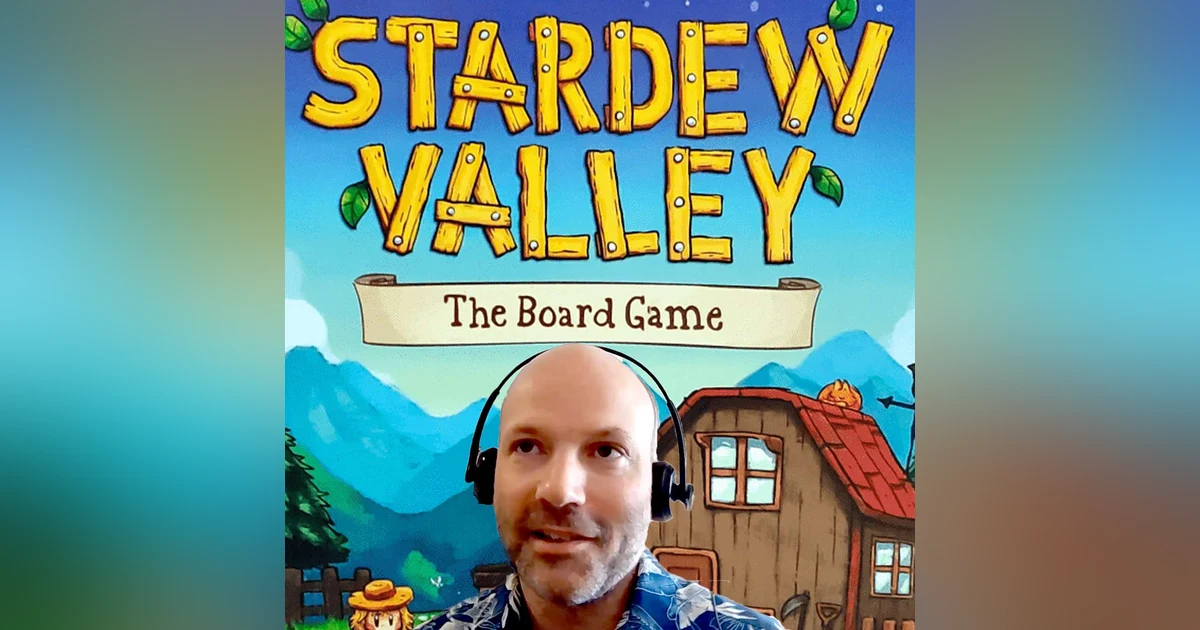
Send us Fan Mail Today on The Examined Game, I’m talking with Cole Medeiros, who was tasked with working alongside ConcernedApe (Eric Barone), the creator of Stardew Valley, to turn one of the most beloved video games of all time into a board game. We talk about the ups and downs, challenges and pressure of not only making a great board game, but doing it with the IP of one of the greatest video games of the 21st century. Cole tells us about the unconventional interview that got him the job,...


Today on The Examined Game, I’m talking with Cole Medeiros, who was tasked with working alongside ConcernedApe (Eric Barone), the creator of Stardew Valley, to turn one of the most beloved video games of all time into a board game.
We talk about the ups and downs, challenges and pressure of not only making a great board game, but doing it with the IP of one of the greatest video games of the 21st century. Cole tells us about the unconventional interview that got him the job, his ongoing relationship with Stardew Valley and its community, and the joy of seeing players engage with the board game he helped create.
We also discuss the constant iteration and evolution that surrounds Stardew Valley, and Cole’s excitement about what’s to come with Haunted Chocolatier.
#stardewvalley #hauntedchocolatier #gaming #boardgames
The Examined Game
Each week, host Steven Lake asks the creators behind some of the world’s most influential video games about the meaning of life (in video games), leading to conversations about the personal and creative impact games have had on their lives.
I was introduced to a concerned ape in a multiplayer game of Stardew, and so it's really weird to meet the creator of the game you're playing while you're pitching them on maybe doing something and you're trying to like poe in a straight line and not not make yourself.
SPEAKER_01You don't want to mix the squish off. He's gone. Sorry.
SPEAKER_00Exactly. Can we do it? There's like this big audience and they have a lot of expectation. And and we did identify a bit of an issue. It never really came up in playtesting. It was kind of just like, oh, sometimes you get stuck for a couple turns. But people were like, this is the worst thing ever. And I was throwing out whole designs and coming back with new stuff. And eventually it's like, okay, I think this is something.
SPEAKER_02Hi there, my name is Steven Lake, and welcome to the examined game. Today I'm talking with Cole Madeiros, who works alongside Eric Barone, who's also better known as Concerned Ape, on the Stardew Valley board game. Cole is a board game designer and was approached by Concerned Ape to basically find a way to convert over what is one of the most amazing video games of all time into an actual board game. And what I love about this conversation is it gives a real insight into all the ups and downs that come from firstly meaning to like win over Eric, who, as you can imagine, is very protective of Stardew Valley. And you know, he found a way to convince him to say, like, yeah, I'm the man who can convert this game over and make it an enjoyable board game experience. Stardew Valley has such a like high quality assurance level to it that anything that goes out with its name on it, you want it to be the best top-notch thing it can possibly be. It's a brilliant insight into a sidestep away from actual video game and some of the peripheral projects that come from them. And there's some really great insights into the way that Eric works alongside collaborators when dealing with the Stardew Valley IP. You can join the Patreon for free for some additional bonus content or become a paying member for loads of great behind-the-scenes content, all sorts of good things. Please enjoy this episode. Thank you very much. I always just kind of I just jump in. I'm always curious to know what someone's playing right now, if anything. Um, although sometimes the making of the work is is is is too time consuming to actually play video games on the side.
SPEAKER_00Yeah, I it's funny. I haven't been playing too many games at this very minute, but I keep being drawn to like older games in my collection, like uh like Fallout 3 and Skyrim. I keep just being, I don't know, pecking around in those those games. Uh I've been watching my daughter, she's eight, getting into uh uh Stardew Valley, and then also she's playing Super Mario Odyssey, and really watching the wonder on her face of like, Dad, I figured I ought to jump up this wall, you know, and I'm like, oh that's cool. So that's mostly my game time has been watching her play.
SPEAKER_02What um what is that? I've I got the experience of seeing my stepdaughter, she was probably 13, un unlocking Stardew Valley, you know, you know, which which was which was my experience as as as well, where like you're like, okay, I sort of see how this is gonna work. I don't know how this is gonna take up a hundred hours of and it's like, oh my god. But I'm just curious, um what it's like for you watching her play that game.
SPEAKER_00Yeah, it's been interesting because she's kind of grown up with it because I've I've been working with him for now oh six years, and it started with the board game, and um uh you know, so she always kind of saw it in the background as she was growing up, and then she starts playing the video game, and it at first certain elements are challenging or even scary for her, like just walking around at first was hard, and then um you know, then the minds were scary, and then now she's like four years into the game, you know, in on her year four of her farm and organizing everything and running around and unlocking new stuff. And um I think what I've mostly enjoyed is kind of when you're watching a young gamer get into it, it really reminds me of like the joy of things that I've now taken for granted. You know, now when I play a game, I'm thinking, oh, this is very well designed, you know. But watching her play, it's like she's really engaging with the joy of some of those components, and she's feeling it, you know, she's excited to watch the butterflies fly through the field and stuff. And and these are things that I've kind of forgotten as a as a game maker in some ways.
SPEAKER_02It sort of sounds it kind of like helps maintain, you know, we we all lose our sort of innocence at some point, right? It must be nice to be in close proximity to to a child, to your daughter, like getting so much pleasure from it.
SPEAKER_00Yes. Yeah, I I think it's uh just a good reminder of what it's really about and that feeling of wonder, you know, that they have. Like in Mario, she found a treasure room and it was just a room full of coins, and she just went, Dad, get over here, look at this. And she was so excited. She's running and collecting all the coins. And I was like, Oh yeah, you know, this is a really joyful moment that as someone who's been doing this for a long time and playing a lot of games, it's like, okay, I got some more coins, you know. It the the wonder is kind of gone. But it's it kind of reminds me of this one time I I purchased a magic trick at a magic shop, and and I was so blown away by how it was. And then they show you how to do it, and you go, Oh, you know, it took kind of that wonder out. But then I showed it to somebody and saw their faces, and I went, ah, that's that's where it is. Like you, once you know how to make the game, then you're you're doing the magic trick for somebody else, and that's where you take the joy, you know, because you now know what you're doing, you know how it works behind the scenes.
SPEAKER_02That's uh that that's kind of like a pretty perfect analogy, I think, I think for exactly that, you know. Um, the joy of passing on to someone else, right?
SPEAKER_00Mm-hmm. Yes, yeah. And at some point that's what I realized that I uh that's why I make games is is really to create an experience that I can then sit there and like I know what's under the surface, but they don't yet, and watching them discover it and enjoy it is is where I get the wonder. Like I'm ooh, that was really fun, you know.
SPEAKER_02Do you do you enjoy like watching other do you know, you know, do you do you watch like um Twitch streamers, or do you like watch just seeing seeing people having like playing the board game and things like that?
SPEAKER_00Like sometimes, yeah. Um I don't watch a lot of video games being played, like sometimes just to get a sense for what people are doing and certain games I haven't played yet. Um I do watch a lot of board game playthroughs or uh especially when like with Stardew when the board game came out and watching people get really excited about it and set it up and and play through the whole game, which would be like a three-hour stream, you know. Um in fact, there was a funny story at one point I was watching and they were like, Oh, I don't know this one rule. I'm not really sure how this works. I wonder if it works like this. And I just wrote in, yes, you got it right. That's and they went, Oh, is this have you played this before? Are you familiar with this? I said, Yeah, I've I've played it before. And it was just kind of fun.
SPEAKER_02Um that that that's that's it's it's always nice when you can like answer the question directly from from from maker to uh to player, right? Yeah. Um what is the what is the lead up to to say that moment where you're on board to to basically find out a way to can convert this this like well-beloved game into a board game. What leads up to that moment?
SPEAKER_00Yeah. Well, you know, logistically, uh, I was introduced to him, uh Concerned Ape by a mutual friend, and uh, you know, kind of chatting about like what it could be. And honestly, that moment I remember because it was a little intimidating, because we did it in a multiplayer game of Stardew, and so it's really weird to meet the creator of the game you're playing while you're pitching them on maybe doing something, and you're trying to like hoe in a straight line and not not make yourself.
SPEAKER_01You don't want to miss a square, he's gone. Sorry.
unknownExactly.
SPEAKER_00So I remember, you know, but it was just kind of like, hey, it could be this, it could be that. Let me poke around and see what we can do. And then from there, spent about a year meeting maybe, maybe monthly, uh, with me brainstorming and playing the video game a lot more, um, trying to figure out like if I were to distill it and translate it, what is the core that needs to be carried over? And then, of course, the format's different, so then different, you know, mechanics or different execution will carry that. But um a lot of study, and I just remember having all these notes about like what is fishing really about, and what is farming, and what are you really doing here, and and what zoom level I often think of projects in terms of like how zoomed in are we? Are you just on your little garden plot or are you at the whole farm, or is it the whole valley? And that that then calibrates me for the level of abstraction, um, basically. Like, if you're not placing specific plots, then the farm is just something smaller and and more you're you're kind of making a lot of assumptions. Um and that's okay because you kind of that's where we landed. You have the whole valley, and so the mines are just a section, the farm is just a section, and yeah, then they need to play together nicely.
SPEAKER_02And then and that's just I'm just curious about that. Was that just because that was the most convenient way to meet, just playing multiplayer in Stardew? Is that or is that a normal way to to uh to to you know I don't know.
SPEAKER_00I mean typically I'm I'm doing you know meetings, you know, like video calls and stuff, but uh I think I think it was sort of um in the tone of the indie game space where you know my my friend um uh Matt was just he's also in the indie space and he was like, hey, let's just get on and play a game together while we talk about making a game. And I think you know, obviously Eric is also very comfortable in in Stardew Valley, and so it's just like, hey, we're just all casually sitting there. Instead of it being like a business meeting where here's my slides, um, you know, that's for me, that's probably one of the the things that was most refreshing and dramatic at the same time, which is I came from Bay Area, like Facebook and mobile games was was sort of what I was doing as a career for many years, and then board games and card games on the side as my passion stuff. And then jumping over to the indie side where things are just you know, we we don't really have all the buzzwords and like the KPIs and and those kinds of you know, discussions. It's more about like how do we make the game really good? How do we make sure players are having fun? Um and uh I don't know, we don't even uh just it's just not talked about in the same way. It's it's it's uh especially with concerned Ape, you know, he's focused on really his own intuition. You know, he's a he's a solo creator, you know, that now has a small team supporting what he was doing originally, but some of it so much of it still comes just from his gut, um and uh his love and care for the community and for the game and and trying to give more that he thinks people would enjoy. That's like his whole focus. There there was a moment, like I said, we spent about a year and then and it was you know pitching a whole game concept and being like, ah, this is not quite right, and pitching another one and saying, Oh, this is closer, but it's missing this, and just this iterative, highly iterative process. And I was throwing out whole designs and coming back with new stuff, and and eventually it's like, okay, I think this is something. And I remember about a year in, we were playing it virtually, because he's in Seattle and I'm in San Francisco, and we finished the game, and he said, This feels like Stardew Valley, and I'm kind of amazed that it exists, like that we put this together. And and he said, Okay, um you know, now let's start talking about how much money is it gonna take to make to make this thing and to hire the artists and to do all the logistical stuff. Um so that was kind of a defining moment.
SPEAKER_02That must have felt pretty but that's that's pretty special, right?
SPEAKER_00It was. It was that moment where I went, oh, you know, uh, I felt a lot of pride and excitement and like, wow, okay, we did it, like we got there. And but you're right. There's immediately following that, it's like, okay, now that just means the horse is out of the gate, and now there's like a long race we gotta run. And uh yeah, so it was very quickly, okay. My mind switches into production mode, and um, but it stood out in my mind as as being uh just a really big milestone.
SPEAKER_02I mean it's it's and it's not not to try and force comparisons, but it's not dissimilar to what we do in the world of documentary where you're taking a source material, um in in that case someone's true life like story or lived experience, and then you're finding a way to to convert this into something diff different, you know, that's going to be consumed in a complete completely different way. Um yeah.
SPEAKER_00No, there's there's uh I think there's an art to that though, and I consider it like a translation thing. And I, you know, the the folks who talk a lot and are good at translation, they understand it's like very difficult and complicated, and it's about finding the the meaning and somehow conveying that meaning in a different language or medium, um maybe summarizing it or snipping little bits out to to be more accurate to the meaning. And um yeah, to I don't know, when I first had you know heard about this opportunity from my friend, I was really excited, but I was really nervous and was like, can we do it? There's like this big audience and they have a lot of expectation, and I'd hate to let them down or fail to be able to make the translation, but um I think like that that moment was when it was like, oh, okay, I think I think we we did it, but now we just gotta make it look good and and make it something we can package and and get to people.
SPEAKER_02It's funny, so again then I know people, you know, a friend of mine runs the the board game cafe in town, and you know he's you know, he's never played a minute of Stardew, but he's played the board game. You're making something that's also gonna reach like a completely new new audience that like for them that is that that's their Stardew Alley, right? For someone who's only played the board game and never played the game. And I suppose that comes back to that that thing that concern 8 said it was like this feels like Stardew Valley, and so now you have like different different mediums within which to uh to enjoy it.
SPEAKER_00Yeah, and I I I definitely think there's a a danger of like if folks see something like Stardew Valley, the board game, and they think, oh, it's probably just you know, it slapped something, you know, the IP on top of some mechanics. But it was a real compliment to me that many people in the board gaming world were like, hey, I played it and it's it's a pretty good board game. Like even if it wasn't I mean, I think the the you know, the idea that it's Stardew Valley is what gets you know a lot of excitement and brings people in because they're so enamored with what what Concerned Ape has built. But it's nice to know as a as a game maker that hey the mechanics hold up and it it's kind of a little bit of both. It's a great world to play in and it's a fun game as well, the the board game. So I've I felt really proud of what we were able to make.
SPEAKER_02And just I guess just to give context to anyone who hasn't played the game, I don't know if you could just give us sort of a real and we'll we'll probably talk, assuming people have played Stardew Valley. Like, what is the digest of the board game? Like, what is the how does it relate to?
SPEAKER_00The thing that I realized with a video game versus a board game, a video game can be very open-ended or relaxed, or like Stardew Valley as a video game, a lot of people treat it as this meditative thing where they don't have they're not forced to do any part of the game.
SPEAKER_02They they get I'm not one of those people, by the way. So it's a very stressful, a very stressful experience. Yes, me too. I'm like, I gotta go finish these. But anyway, yeah.
SPEAKER_00Yep. Um but with a board game, that open-endedness uh often doesn't work. Although I I have heard of a couple of board games that took a run at something that's open-ended and just can go for as long as you want. And that is just a the average person who's sitting down to play a board game expects something self-contained, they sort of win or lose, or have some sort of thing happen after, you know, a couple hours at most. And so what we landed on is we have to then set an objective, which in the board game is restore the community center and also um complete uh some of Grandpa's goals. Um there's eight possible, but you get a random set of four. And by uh engaging with the mechanics in the game, like farming grows crops, or moving around lets you collect forageables, go to the mine to get certain resources, or or you can meet villagers and make friends. So there's all these mechanics like that. Um fishing also, those feed into those objectives. And so you're you have a certain limited number of turns. Um four for each season, and then um oh wait, that would make uh 16. Sorry, 16 turns, and then um at the end of that, you've either completed all those objectives or not. Um and uh so you're trying to get fish and and forageables or animal products, friends, things like that. And once you've put them into the bundles or completed Grandpa's goals, you win. Um and if you fail to do that by the end of the turns, uh kind of better luck next time, you know. Uh but it's it's funny, somehow, you know, when we were playing it, Eric was always like, I feel like it's too easy. We were able to beat it. It's a cooperative game, so you're playing all on the same team, not against each other. And he's like, I feel like I want it to be a bit more challenging. And I was kind of worried a little bit, like, ah, if it's too challenging, does the game become too stressful? And then we get too far away from that relaxed, fun feeling that the video game has. But I do think the game is a bit more challenging than people expect. So there's a bit of a disconnect between the you know, the video game crowd and the board game crowd. But it kind of works because I've heard from a lot of people, they say, Man, we we won or we lost, and it was by one action. We just it was so close. And and that just makes it like, oh, we did it. It was so or like, ah, we were so close, let's play again. Um, and so it really somehow it works. And I I can't even take all the credit for that because sometimes I feel like the system spits out things I was not expecting, and you just get that perfect card right at the right time, or people use it in really clever ways, and and I go, wow, that's that's really exciting that it does that so often.
SPEAKER_02When you're making a board game or a car game, you know, building something out, and say that say that it's not Stardew Valley, but way that there's no there's no pre existing source material to pull from, right? At least for you, say, what is that? So this is my first question to lead to my bigger, more complicated question. What is the what is the very first uh jumping off point? The kind of spark of inspiration. Is it a mechanic, is it an idea, is it a concept?
SPEAKER_00Different people approach it differently. I the way I tend to approach games, and I think it's because of the kinds of games that I enjoy. Like I really like stories, I like experiences, I like going into a game and not really knowing what's gonna happen and coming out go, wow, that was amazing that we pulled this thing off, or or this. So I I have a high tolerance for randomness or luck. Um but I still want to meet feel like I made a you know some real Really interesting choices and then had this kind of story experience come back at me. So I typically, when I'm starting from scratch, start with a feeling or an emotion. So I'm going, oh, I want I want to feel like uh and it's it's usually narrative. I want to feel like I'm a secret agent or a spy. And so, okay, what what kind of format of a game best supports that? What mechanics would be in that game? And I I typically do a lot of research then on what does that mean to feel that experience and why is that appealing to me? Like what am I trying to again, what am I trying to translate into a board game? Um and so and that's the that's always kind of the starting point. And then I start sketching and saying, okay, let me draw some components um just on a piece of paper and kind of uh wrap my head around how could I is it decks of cards, is it tiles? Um what's the mechanics that support that experience that I'm excited about? Uh so that's always my starting point.
SPEAKER_02And so then in the case of Stardew Valley, where are you what is your first starting point when you've also got this source material over here that you're trying to converge with a good gameplay mechanic?
SPEAKER_00Yeah. With Stardew, like I said, I played it a whole bunch and just thinking about like if this game were a pie, how would I cut it up into its slices? And what are those slices? And then it was like, okay, well, fishing is a slice. So let's focus on that and and come up with the system that supports that, you know, and and ideally it overlaps with the other components, like it's using the same dice, but maybe in a different way, or it has its own tiles. Um and I just kind of iterated on these individual components until I was like, okay, this kind of feels like fishing, like I'm throwing some dice, maybe I have some re-rolls, I'm catching different random fish. Um we played a lot with I played around a lot in the beginning with um like pulling tiles out of bags, um, which I realized digitally works fine because you just click on the bag. Physically, it's a little bit like cumbersome to like do this so much. So these were things I started limiting or leaning into based on just like how did it physically feel? Because it's so much of I think the joy of a board game is having something on the table in front of you that you're holding, that you're leaning over and you're talking with people around the table.
SPEAKER_02There's there's things like you know, is is is in its very nature Lord of the Rings a really good source material for board games. Is Star Wars a really good source material for board games? Is there something inherently and and the I suppose the other thing about this is much those, much like Stardew Valley, there is something about them that is extremely special, right? Like they could they they caught on like fire because they they tap into something that people just absolutely adore. And I suppose my question is what of that absolute almost most meta foundation that is Stardew Valley is that that that that you know pre-exists before you even start making this game? What if that is helping you uh as a foundation to really make a really beautiful, wonderful board game? Does that make sense as a question?
SPEAKER_00Yeah. I think that the it's like the vividness of whatever that specialness is, like how distinct it is. Um it it's almost like um getting a palette of paints and be like, oh, this one's bright red, this one's bright blue, okay, great. I know how to paint with this now or what I'm gonna make. Um when it's a bit more subtle, I think those environments are harder to work with because you're like, ah, what? These are all shades of green. Like what? How can I I need to like really understand this thing. But you know, like when you look at Star Wars, it's like great characters, you know, this philosophical conflict, and you know, a conflict on multiple levels that's fairly stark and distinct, and big spaceships and aliens and robots, but you know, that's all fun, but then there's these core pieces that I think everyone has come to identify, you know, good versus evil and um Jedi and the Force, and you're like, okay, I know how to build something really cool that uh could be inspired by those things. And with Stardew, it's like I had to lean in and be like, well, what is really the that core? And I think it's this idea of connection, collaboration, of really investing yourself in something and building it up and seeing that progress over time, um, seeing the seasons pass. Um and I've come to realize also that there's these fundamental themes that humans have, like that everybody is, you know, they know about. And like one of them really is farming. I think it's just historically in us. And so when you say, hey, you're gonna put something in the ground, and then you're gonna plant something, and then it's gonna grow, and you're gonna nurture it, and then get some reward, and then you're gonna share that reward with people, like that's just it's like, okay, I understand that, and I'm invested in that, and I want to do that. So I think that's really something that we just like wove into that board game experience, but it's already woven into the the video game, so it's very clear.
SPEAKER_02You did get me thinking, and this is just for me, obviously Stardew Valley did it is multiplayer, but in how it was originally built, you know, and how it existed for a long time, it's very, very much a single player game. And certainly the way I play it, I mean, my first two playthroughs, I I barely I got married, but that was it in terms of like um it wasn't until my stepdaughter played it and she showed me all of these amazing interactions and the cutscenes and things. I was like, oh my god, I've like I'm missing out on this entire and I'd probably done about 50 hours, 60 hours at that point of playing this game, and I hadn't even touched that, and then and then obviously I went back and dove into it. But what what I'm getting at is for me, the game is actually in some ways very um it's very isolated experience. You you spend your time on your farm, you're on your own. Even even if you get married, you you're doing so much stuff just in isolation, you're kind of running past people and then back again and stop for a quick chat. But what I'm getting at is by obviously by its very nature of being a board game, it is that fully cooperative, connected um experience.
SPEAKER_00Yes. Yeah, the the board game, you can actually play it single player. Um, and that's the way that I I sort of built it on one player and then scaled it up for multiple players. And so it was kind of a way to forgotten that, yeah. Tune it, you know. It's like, okay, if if one player needs one fish, then two players need two fish for this, you know, and it it luckily scaled pretty well across all the different goals. Um I don't know, maybe that's debatable, but I I think overall it scales pretty well. But um and it's interesting you say that you know, Stardew Valley, it did start as a single player experience, and and I think as multiplayer came in, um I find myself almost exclusively playing when I'm playing with somebody else now. And um just because the it's just so much fun to be like, hey, you'll go fishing and I'll do this. But there there is something you kind of lose in that where when you're playing by yourself, you're just sort of uh totally um you have full agency. You're not you know discussing anything with anybody and you're choosing what you do, and when you go to sleep and it goes to the next day, and it's just kind of all built around you in this little quiet world, so that's different.
SPEAKER_02It is it's very different. The pacing, the pacing changes as soon as I'm playing with someone else. And then and then just to sort of go back to that timeline, so for you, so you you know, you come on board, you work on this game, and then you know, you you you've obviously continued to to to work with concerned eight since then, right? Like what is what is what is what has life for you been like both both you know within this project or other things you're doing since since the the launch of the board game?
SPEAKER_00That was yeah, the the launch was a really exciting time. Um I have a funny story from that. About a week before the game came out, I think some my guess is somebody was driving a truck, moving a bunch of games, and they recognized that it was Stardew and they were a fan and they got excited and they took a picture and we saw it on Reddit, and so it it leaked, and uh, which wasn't that big of a deal, but it was it was kind of interesting. And I was telling somebody about it, and my daughter, very young at the time, came up and said, I'm sorry your board games got wet, dad. She thought that and leaked on. And I'll always remember that. It's just a funny moment, but but that's very wholesome. That's yeah, that was so cute. Um, but yeah, it was really exciting. And then around that time, uh I can't remember if it was maybe a little bit before or um, but Eric said, you know, hey, I've really enjoyed working with you. And um uh there's a ton of businessy stuff that you know, I'm really it's a distraction from me making the games that I would like some help with. And if you would like that role, it's kind of just a catch-all role of email, business development, just all of the things that are not making the game. Um and so I was like, yeah, that would be great. It's been really fun working together. And at that time, my uh role was similar. I was like kind of like a producer, project manager person. And so I said, Yeah, let's do it, and jumped in and then just started handling more and more of just everything that is not directly making the game, uh, of which there's a lot because we're very small. Like I'm one of three full-time employees, um, and then we have a you know a handful of contractors, but the the everyday team is you know, between five to ten people, and um it's kind of uh just been wild seeing his success and the success of the game and the growth of the community. I think when I started it had sold a little over 20 million copies, and now it's over 50 million, and you know, we've just gone to like we've traveled a handful of times to go to the concerts, the live concerts that are happening, and seeing an audience of fans being really excited about Stardew music, and uh it just really kind of shows you the scale of the the love and passion around the game, and it's really fun to be a part of that. I I just feel like it's a great honor.
SPEAKER_02I can imagine. I mean, it sounds like a beautiful thing to be c connected with, you know. Um it made me think, you know, I spoke with um Kelsey and Alex Beecham, Kelsey the writer and Alex the you know creator of of Outer Wilds, and they're sit they're similar to games to me in terms of not not the games themselves, but hearing hearing the way you talk about the community and people, and it's certainly the way that that that game has gone as well. There are certain and you know, um no community is without its j occasional jerk, you know. Um that's just too hard a word, but you know what I mean. Um but that said, like but it it it feels as if Stardew Valley has, and maybe it's the it's perhaps it is the nature of the game, you know, that does that, but it's cultivated this really like fierce but really like loving and and and beautiful and and kind uh fandom, right? That the you know they don't want to ruin things for each other and they're supportive of each other and trying to sort of build up the community. And yeah, I guess I just wonder what that's like for you all, just seeing that from from the inside.
SPEAKER_00It has been really great, I think. Like the fans are overwhelmingly excited and they love the game. Um, but it it for many people it's like more than a game. They've they've tapped into it as a source of comfort or sort of therapy, or it's gotten them through very difficult times in their lives. And so, yeah, it's it's a really warm community, which yeah, I think is a little bit rare in video games because video games are often about challenge or competition. And in those groups, it's like you're fighting to be the best. Like even if you're friends, you're like, you know, going head to head and there's an intensity there. So when something breaks or something is not balanced or there's bugs, there's a lot of anger that comes with that. Um and you know, I think we're we're not without like fan frustration. I think that's universal. When anybody loves something and it stops working, they're like, What are you doing? Um, but they also uh really appreciate how he's been as transparent as possible and as direct as possible about what he can do in a limited amount of time, what we can do as a team. Um and even the angriest emails, you know, I just respond and I'm like, hey, you know, how can I help you? And they go, Oh, I didn't think I was gonna get a hold of anybody. And I'm like, Well, we're doing our best, you know, what can I do? And and it often turns into an opportunity for uh to to turn that anger into like, oh, you know what, they're actually working hard over there.
SPEAKER_02Through my experience, when I respond to I won't respond to uh you know every comment. Yeah, but but if it's like ir if they're irritable, but they're and sometimes usually there's a nugget of of information in there that you can extract, you know, it might it might be a bit of feedback or something. It's just it's wrapped in a uh poorly wrapped and and exactly that you you you respond uh courteously and and it sort of cuts to tension um all of a sudden. And sometimes they're almost not embarrassed, but they're like, oh yeah, I didn't think they would get it, they didn't think they'd get it get a response to their salty email, you know. Yep, exactly. Um but it is it does feel like the the game, you know, the get the good it's there's a lot of goodwill there, right? Certainly, you know, a lot. I mean, some games don't get a lot of goodwill, you know. You know, yeah. You know, I wouldn't want to be making a triple A like RPG right now, you know.
SPEAKER_00Um yes, yeah. It it's just you're setting up high expectations. But I think his story is so unique and interesting. I I just don't think there's too many other games out there. There are, you know, but it can say the exact same thing that you know he just sat down by himself for four years, made this game based on something he loved, and then continued to support it with free updates for over a decade. And the amount of content, the amount of care, he just put so much effort into everything down to the pixel. Um so it's I look at it, I'm really impressed. You know, I sometimes I'm looking through all the pixel art or the music, and I said, How did you do this? Like, really, how did you and he's like, you know, you just if you just keep working on something for a long time, it gets better, and you get more of it, and uh he just keeps coming back to it.
SPEAKER_02And then I'm just curious for you. I mean, it sounds like you're sort of squarely in the bed of of what you all are doing there. And I'm I'm asking this with real a real awareness that it's like even if you'd like said something that rhymed with haunted chocolatier, you know, that there's a risk of of someone misconstruing or misunderstanding. So we don't don't need to go near that with a barge pole. But just for you personally, like what you're interested to see sort of more of, you know, in terms of like um, you know, the the things that you would like to sort of be working on in the future, or be that in the gaming space or in ball games or or or whatever, you know. I'm just doing I'm just interested in people's sort of future-facing ambitions, or what they'd like to see more of for from other people as well.
SPEAKER_00Yeah, I I don't know, I feel so sort of uh focused on the day-to-day at this minute. Like sometimes we kind of have plans for oh, this is happening in the future, but um we're kind of in like a more heads-down phase right now where he's trying, you know, there's an update that's being worked on for Stardew, and then um like haunted chocolatier uh is cooking. Um, and I see little glimpses into that, but it's funny because he still um continues to be I don't know, just he's kind of doing it the same way he did Stardew, and he's just trying to sit down and work on it, and like occasionally he's like, Oh, hey, here's a screenshot. Or I used to joke that I would get more information from his Twitter than I did from him directly about haunted chocolatier because he'd just be like, Oh, I'm I'm working on it, you know. And um, and and sometimes I wonder too, like there it's tough, I think. I would imagine it's tough not to feel a tremendous pressure after the success of Stardew to be like, oh, let me go work on my next game. And you know, because there's a lot of people really excited about it. And you know, it's he's he's super talented and very humble and hardworking, but it's game making is very difficult. And you know, you sit down, you try to make something, and and you put your heart in it, and you hope that it will be something that people enjoy, but it's it's very hard to know. So I think he's trying to, you know, not think about that too much and just like kind of just make something that he's excited about um as much as possible.
SPEAKER_02It's interesting you talk about a head-down phase. I my feeling with with you know what you all are doing is it's basically a perpetual head-down phase. Like there's never really any, you know, there's never nothing's ever done, right? There's either there's either there's either updates for for the Stardy Valley or it's working on the the next one. But I guess just to to sort of maybe finally put that question to you then about the um what it was like putting that board game out into the into the web. But there must have been a moment where you s you realized, oh my gosh, I've actually made something that's like because I I don't know if you're anything like me, but I don't know that it's good, like really good, until until someone else is is loving it just as much as I love it. Yeah. I'm just curious about that that moment for you.
SPEAKER_00You you definitely want I grapple with that because you know artist creator friends and I, it's like honest, uh you want to try to make something that you love and then be proud of it and not have it be so dependent on the feedback of others. But it ironically, you're making stuff for other people. So if if they don't watch it, they don't play it, they don't really like it, it feels like a failure. And we put the board game out, it was wild. We had printed 20,000 copies, and they we thought that would be enough for a first run because it's a pretty big run for board games, and they sold out in one day, and it was like, oh my gosh. And I'm thinking, well, we gotta print more. Like, there's we met the demand, and there's more demand. Like, what are we gonna do? And and he was like, Well, hold on a second, let's let's wait, let's just wait a little bit. And I'm like, Oh my goodness, like, what are we doing? We got to do that.
SPEAKER_02Waiting is something that I feel like like Eric's probably quite good at, right?
SPEAKER_00He knows how to wait, you know, yeah, he knows how to be patient and just like be like, okay, let's think about this for a second. And he was he was right because uh there was a lot of excitement, and then people got the games, and overall, I think it was positive, but there were some pretty sharp negative pieces of feedback. And he was like, Why are we getting that? What is that, what is in that that we could act on? And I was like, Well, you know, there's a lot of expectation for this board game, and and sometimes the board game crowd can be really intense about you know the thickness of the paper and and all kinds of things. Um, so I was thinking, oh, maybe it's not that big of a deal. But ultimately, uh, and there was a time in there where it got some big reviews that were negative, and I I struggled with it. I was like, man, they hated my game, and I thought it was pretty good, and and you know, it was you you have this vast majority, I think, that are silently enjoying themselves, and then you have a vocal, smaller, maybe critical uh folks. But but he was right. He was like, let's look at what they're saying and think about that, and we did, and we did identify a bit of an issue, something that could happen that was not so great in the minds. You could get stuck on a level, and it it never really came up in playtesting. It was kind of just like, oh, sometimes you get stuck for a couple turns, but people were like, This is the worst thing ever, this is terrible, this is you know, and so I ended up making an adjustment to those cards, and we did a the next printing was slightly different, and um big improvement to that particular part of the game. Um and then we we printed those going forward, and um and then it was kind of like in the middle of that run that like even folks who said, Ah, this game's not very good, they said, Well, I played it again, and actually it is good. There was stuff I missed the first time, um, and then there were some people on BoardGameGeek that like very vigorously were championing it, and uh listening to them show up and and not argue with but kind of provide counterpoints to some of the criticisms again and again and again, and then the ratings were pretty solid and it kind of smoothed out, and I went, okay, like uh I felt like the game's good. I think it is good. It's not for everybody because some people won't enjoy this particular mix of luck, and maybe they don't like the strategy or the theme, but it does seem to be working for the majority of people who are showing up for a Stardew themed experience with some challenge and and decent gameplay. So I was like, all right, this is this is going well.
SPEAKER_02I love the idea of like debugging a board game, you know, when you're like you're like it's like we found some bugs we need to yes, we totally did.
SPEAKER_00And he was even like, you know, how do we do an update? How do we send all the people the new components? Because we're often pushing updates, you know, that's the whole thing for the video game. And um, and we do. We actually, if anybody wrote in and said, hey, um, like I've had people write in and say, I've been playing the board game since version one and it's great, but some of my components are falling apart. And I was like, Man, you must have got that, you know, five years ago. I'm just gonna send you a new board game. Like, I'm gonna send you, I'm gonna upgrade you because you're a passionate fan, and like let's get you the newest components. And um, and I just think that goes a long way towards this whole thing. Like the the Stardew thing is is about let's keep having fun, let's keep playing games, and um celebrate this thing that we all enjoy.
SPEAKER_02That's such a lovely note thing to end on. I just love the idea of an you know, an update coming through the post, right? You know, it's not like it's like waiting for like a a four gigabyte download back in the naughty. That's gonna take two to three days uh for you to get your update, but it's but it's coming.
SPEAKER_00The little loading bar. Just yeah, oh, that's beautiful.