Restoring the Mona Lisas of video games | Larry Kuperman (Nightdive Studios)
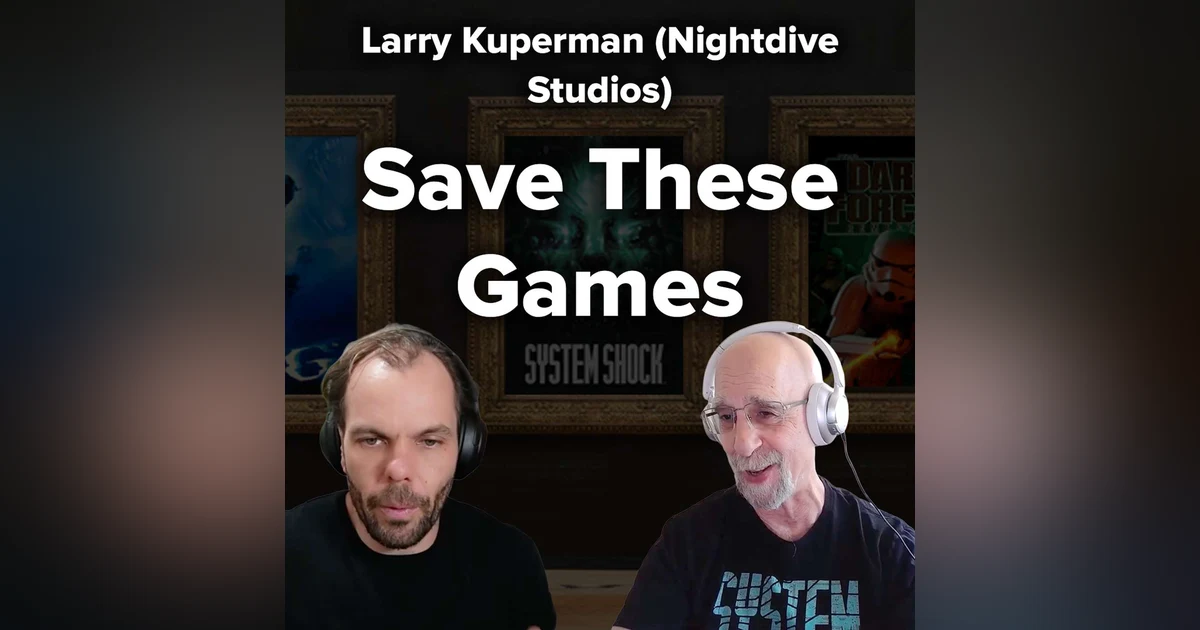
Send us Fan Mail In today’s episode I speak with Larry Kuperman, Vice President of Business Development at Nightdive Studios. Larry retired not long after this interview, so I was pleased to chat with such an industry veteran. Nightdive have made a well-deserved name for themselves with their remakes and remasters of classic games including System Shock, System Shock 2, Blade Runner, Star Wars: Dark Forces, The Thing, Quake and many others. I sat down with Larry to discuss the ups and downs o...


In today’s episode I speak with Larry Kuperman, Vice President of Business Development at Nightdive Studios. Larry retired not long after this interview, so I was pleased to chat with such an industry veteran.
Nightdive have made a well-deserved name for themselves with their remakes and remasters of classic games including System Shock, System Shock 2, Blade Runner, Star Wars: Dark Forces, The Thing, Quake and many others.
I sat down with Larry to discuss the ups and downs of remastering and remaking games. We talk about player expectations and the legal maze involved in resurrecting these games. How missing source code, lost contracts and rights ownership make for a “fun” puzzle when it comes to getting these games to see the light of day again, as well as game preservation and the technical challenge of bringing older PC games onto modern hardware and consoles. Based on Larry’s experience, some games are far more difficult to preserve than others, and we get into the “games that got away”, at least for the time being. The studio’s current white whale being No One Lives Forever.
We talk about nostalgia and why certain games stay with players for decades. Larry talks about growing up during the early PC gaming era, the impact of studios like id Software and why games like Doom and Descent mean so much to him as games he played with his son. We also discuss the emotional connection people have to games from the 1990s and early 2000s, and why replaying them can feel like reconnecting with a specific moment in life. This leads into the pressure that comes when you, as Larry put it, “remaster the Mona Lisa of video games”.
The conversation also covers Nightdive’s early relationship with GOG, the decline of physical PC games, digital distribution, modding communities and the growing importance of game preservation, and why the goal is not to recreate games exactly as they were, but to make them feel the way players remember them.
We also get into titles like I Have No Mouth, and I Must Scream, No One Lives Forever and SiN. These are the games of my youth, so talking with Larry on this subject was, for me, fascinating.
The Examined Game
Each week, host Steven Lake asks the creators behind some of the world’s most influential video games about the meaning of life (in video games), leading to conversations about the personal and creative impact games have had on their lives.
00:00 - Introduction
02:14 - Joining Nightdive Studios
06:03 - Bringing back System Shock 2
10:48 - The challenge of game preservation
15:22 - Missing source code and lost contracts
20:05 - Rights ownership and legal issues
25:14 - Remasters vs remakes
30:41 - Why some games are harder to preserve
35:27 - The games that got away
39:52 - No One Lives Forever
44:08 - Blade Runner and restoring classic games
49:11 - Star Wars: Dark Forces and fan expectations
54:36 - Physical PC games and the early industry
59:22 - Doom, Descent and early PC gaming
01:04:17 - Playing games with his son
01:09:03 - Nostalgia and emotional connection in games
01:14:20 - Modding communities and preservation
01:18:44 - GOG and digital distribution
01:23:18 - Remastering the “Mona Lisa” of games
01:28:56 - Modern audiences vs original design
01:33:40 - The future of game preservation
01:38:12 - Final thoughts
Introduction
SPEAKER_01So so just let me ask uh rephrase that question. You're asking me about when I am called upon to restore the Mona Lisa, if that makes me nervous. Yes. Um seriously, and and and and I say this to anyone that's been uh on the side of game development. There's there's the night before something goes live. And it's it it's minutes of elation separated by hours of pure terror.
SPEAKER_03Hi there, my name is Stephen Lake, and welcome to the Examined Game. Today we're talking with Larry Cooperman, the vice president of business development at Night Dive Studios. He's had a rich, very long career, worked for the likes of GameStop, Stardock. But what we really get onto with Larry is the sort of pressures and considerations that you have to take into account at a company studio like Night Dive, where you're basically pulling out people's favourite toys from their childhoods or adulthood and then sprucing them up, remaking them, remastering them, and then putting them back out into the world, what it's like to sort of deal with that level of um expectation, and how Night Dive has really built kind of an amazing brand for itself because it is such a reliable go-to when it comes to playing these, at least for me, these kind of treasures from my childhood and my past. Really enjoyed my conversation with Larry. He's a sort of very engaging and thoughtful individual when it comes to this stuff. He's obviously thought about it a lot. And we also get a little bit into the kind of the legal side and how what it takes to sort of pull all this together on the back end, the considerations that Night Dive has to make before they even start making a game. You may or may not be aware that you know, with the likes of System Shock and their other games, there's usually a bit of a quagmire of legal stuff they have to get through before they can even get started on it. And Larry really goes into detail about how such a company pulls that off. Please stick around, please subscribe. Thank you very much. How long have you been at Night Dive now?
SPEAKER_0113 years. I joined um Night Dive was started in 2012, and I joined in 2013.
SPEAKER_03Um, I it it's funny, I
Joining Nightdive Studios
SPEAKER_03actually had no idea that you would have been around that long. Um I've I've I've definitely been playing stuff that you've been putting out for quite a while, but in terms of the presence of the studio, it sort of feels as if the last couple of years it's kind of skyrocketed. I don't know if that's the same perception internally, but well, we've we've certainly grown.
SPEAKER_01Um let me share the other side of that. Um, it's something that I say to Stephen Kick all the time. It it only took us 10 years to become overnight sensations. Uh so yes, there was steady growth. Uh the the company started when Stephen acquired the publishing rights to bring System Shock, uh System Shock 2 back. So he's famously told the story. He was on sabbatical, found that there was no legal way to play the game, used his his the that free time to research who had the rights, contacted them at just the right moment. Um, they were looking for a means to uh demonstrate commercial usage, which is a necessity for maintaining you know trademark and copyright on things. Um so so he called them at that right time, got those rights. Um, the company was started and was successful almost immediately. Um they had just acquired the most highly sought, anticipated game on GOG.com. Um and in fact, it it's something we'll talk about, but but our relationship with GOG has been our longest, oldest partnership. Um but we we started off there, moved the game to uh Steam, and again it was it was quite successful. Um Steve was found himself in the position of where do we go next? How do we how do we take the company to next levels? And um he'd he done some some other acquisitions. I think there were a total of of maybe five or six other games besides System Shock in the Night Dive portfolio when I joined. And uh one day he gets cold called by this guy who's been in the industry for well over a decade. That would be me. And um had contacts with every major company and quite a few minor ones because of the work that I had done um on on done as part of Stardock and then as part of GameStop. Um so Steve said uh when when when we met uh our at at our at the first GDC we went to together, I asked him who he wanted to meet with, and and he was kind of surprised by that question. Uh geop, everyone. I said, great, we're starting with Activision and we're not stopping until we get up to Xenomax. So so there we are.
SPEAKER_03And uh, I mean I don't want to, but I mean, uh look, you know, looking at the roster of games, like how is that uh is it does does one have to sort of separate out their own kind of like dream wish list of games they want to see sort of back out there on the market versus what is um tenable and sellable, you know. I mean, I see, you know, I'm I'm a was I'm a big point and click gamer, so for me, things like Blade Runner and I have no mouth, I must scream. It's just like the most incredible thing in the world to have those um back in my hands, but I'm assuming that perhaps those are the lesser far-reaching um projects than others.
SPEAKER_01Um it it there are some surprises there. Um I have no mouth and
Bringing back System Shock 2
SPEAKER_01I must scream, which I it even as in my parental feelings for games that I've I've brought on, um uh you know, even that one was a bit obscure. Um Steve um had a relationship with Harlan Ellison. That was one of the titles that that predates my joining. But um that game became a uh um an internet sensation maybe a year or so ago. Um it got picked up on TikTok as one of the hardest games for a variety of reasons ever to be played. And I would I would certainly agree with that. Not only is the the game itself challenging, but the subject matter certainly is. Um that that being said, we realized that there was a huge potential console audience for that. And there we go. Um, it was it was one of those titles that was um was a stretch outside of what we normally do at uh at nightdive. Um we always talk about how we make remasters, games like oh, Star Wars Dark Forces, the thing, um, you know, the the titles that people are are perhaps most familiar with. And and we make remakes like the System Shock remake. Um probably the the crown jewel of Night Dutch titles. But sometimes we can't do that kind of full work. The the resources just just aren't there. Um source code can't be found, or or or for what whatever reason. Um and so recently we've started working with partner companies, um, specialists in the emulation area, so that we can do those, and we're referring to those as as restorations. Uh I can't improve on it, I I can't really do a full remaster, but what I can do is restore the original playing experience on today's modern hardware. And and I'm really glad that you uh that you mentioned Blade Runner. Um, Blade Runner was was really challenging for us um because also the the source code doesn't exist. And the game had had been ported um uh previously or or close to simultaneously using Scum VM. Um I don't think most of the people in our PC audience understand that the reason that we took on the project was because it was only available on PC. And and that there are vast numbers of console gamers who were requesting the title but but couldn't play it because we were unable, uh, we were unable to port it, you know, it didn't exist on console. So we stepped in. We couldn't do as as full a job on it as as we would like. We simply the resources weren't there for us. Um and when I say the resources, I don't mean our resources. I mean, there are things that we need to start from. But um what we were able to do was very successfully port the game onto consoles as is. Again, more of a of a restoration than a full remake or a remaster.
SPEAKER_03Well, again, I mean, great job, at least on the me being on the receiving end of that, you know. Um I mean it's sort of and one of the things, well, again, there's so many places I want to start from, but I suppose I'm uh assuming that you know the uh the sense uh you know, sentimentality is something that uh works in your favor, right, for getting people to buy these games. Um and I guess I would just like to sort of in it's it's kind of broadening things right out about what what it is about these games that made them the sort of treasures that they have become. Um and I know every single one has its different sort of um traits, but there's definitely an era that you seem to be covering um from sort of PC gaming.
SPEAKER_01We've we we've kind of expanded somewhat. We we really began in the in the the late 90s era, but um we're now doing games that are are are somewhat more modern, involved in the early 2000s. I I will also share with you that there is a considerable um jump in difficulty. Uh the scope of the games, the size of the
The challenge of game preservation
SPEAKER_01games, the art style of the games certainly makes those changes um more difficult. But um we continue to evolve and we continue to grow the company. Um one of the questions that that perhaps we would have gotten around to, uh I mentioned about my joining the company um uh about a year after it had started. Um joining the company sounds kind of pompous for what happened, really. There were three of us. Uh Daniel, DeGracian from uh from the UK, Steve, of course, and me. And uh the amount of work that we did in the early days that we we we uh were able to grind out. Um I think people would have been would have been uh impressed to know that there were that there were there were a limited number of hands behind behind those projects.
SPEAKER_03So sort of humble, humble beginnings, you know.
SPEAKER_01Yes.
SPEAKER_03Well, as you said, and there that's that thing that I I mean who knows who coined the phrase overnight success, but I don't know if there there's ever actually been one. And if there has been, it was literally a maybe a 24-hour uh window of success and then it's done. Because I think when you build something from the ground um up, um it takes that much time just to be able to sort of get momentum going.
SPEAKER_01That was that was always our our concern. Um I I don't want to I don't want to put on any airs in the early days. We were happy to be surviving and and working on what we loved. Um when I joined Night Dive, um one of my friends from both the Stardock and the GameStop era, Mike Cressweller, um, said about me, he says, You're gonna be working on games from the period when you learn to love games. And and that's true. Um that that that that certainly that certainly is the case. Um but you know what what we feel the the pressure on was to build something sustainable. The reason we were working on these games in the first place was because they had been lost. And and we didn't want to have um another another era where where where these games came out and then would be lost again in the future. So we've been very careful to try to to try to build something. Um there certainly is, you know. After I joined, um, the the next employee that that came on board um was was Sam Villarreal, uh better known on the internet as Kaiser. And Kaiser had been working in his free time on on porting games, on creating what became known as the Kex engine, uh K-E-X. And that is that is really the brainchild of of Kaiser. We wanted to we wanted to have something that would be sustainable, that that we've used the Kex engine for basically all of our our remasters. There have been a couple of exceptions, mostly as we discussed, in the point and click area, but but the majority of our games, vast majority of our games are built in in Kex. Um those those titles that that aren't. Um we have uh one title that was built in um in Unity, um, that was from uh an outside developer, Spirits of Zanadu, um a corridor shooter, that when we saw it, it it was the closest to the aesthetic of System Shock 1 at the time. And so that was a natural for us. Um other than that, we use Unreal for our our remakes of System Shock. Um we're trying to stay where there's going to be sustainability, where where years from now people will remember what nightdive did.
SPEAKER_03And I mean, I I'd love if you could just talk a little bit about again that idea of sort of sentimentality, and because I was assuming that's the driving force behind why, say, with GOG, you've got that, you know, the most desired game there, you know. Um and and how you sort of um well, firstly, I suppose why how how that comes about for these games, that they aren't forgotten, you know, and that they just seem to carry over like year in, year out. People still talk about them, do people still write about them.
SPEAKER_01I I perhaps sidestep the question about about how the games were originally created and focused on on how we remastered them. But but let's talk about the original creation and why these games
Missing source code and lost contracts
SPEAKER_01are are so special. Um you can take a look at at what happened in Shreveport, Louisiana, uh, when John Carmack and John Romero, uh uh Adrian, Kevin Cloud, when when those people came together and and would would create you know a series of of games, uh the the foundations of id software. There's no other way to describe it other than magic. There really isn't. No one told them that they couldn't do those things, so they did. Uh, you know, from from Carmac creating the the first the first you know true game PC game engine. Again, it it was magic and it was an homage. I I've gotten to work with and and to to sit down and to interview with not just John Romero, but but um um Warren Specter. I mean some of the the greats of of our industry. Um the the team over at id, you know, uh many of those people now at machine games. Uh we we've gotten to work with those people, and and nobody can tell you exactly why something comes together that way, why it resonates. But there are a couple of things. First of all, the video games from from that era were were all pretty much breaking ground. Um, even all of the Doom clone doom clones, sorry about that, the Doom clones that came out in in that era, um, all of them were were innovative. Um titles that were were described that way as a Doom clone, Star Wars Dark Forces. I mean, that was just a brilliant game. Um, and and that that's not because we did a remaster of it, that was because it was it was a title that we loved. Um things come come together that way, uh, especially when you're you're you're you're building the bridge that you're crossing on. You're you're you're making it up as as you go. Um I I remember um hearing Matt Toshlock, um who who was behind among among other titles, Descent, one of the games that that really made me want to play games. Um I remember Matt talking about about how he got started, how how how a project would start. And they would be at the whiteboard, and step one was, okay, first let's build the engine. There wasn't Unity, there wasn't Unreal, there weren't canned engines out for it. You you started from from ground zero. And I think that that was I think that was part of it. I think that the challenge of of of inventing things as you went um really came along. You go back to some of the the early games. Um you look at what games were bef before Doom came out, and Doom changed everything. I mean, yeah, so uh I I just have a tremendous amount of appreciation for those those geniuses. Um the other thing that that I've been reading uh about recently a couple of good articles on it, is um neurodivergence in the game industry. Um I think it is perhaps more more prevalent than than people know. Um I think that there were uh a whole bunch of us from 25-30 years ago that that were considered quirky at the time, um, that would now have uh have a diagnosis attached to to that that quirkiness. Um I I think we were I think the field attracted people who were who did not fit into other other areas. Um just so that you know, I have a master's in business administration degree. I worked for 17, 18 years in in healthcare finance. I did other jobs before this industry. I never felt like I I fit in until I joined the games industry.
SPEAKER_03And was it because I was thinking, you know, you're talking about, I mean, it sounds like we were sort of playing descent at the same time, but there's, you know, if you don't mind me saying there's an age gap, you know, that's you know, but sort of finding those sorts of games, you know, and sort of being being sort of um I don't know, converted ir irreparably so.
SPEAKER_01One of the uh
Rights ownership and legal issues
SPEAKER_01what one of the fun things, uh part of the the magic between Steve Kick and Larry Cooperman, part of the reason that that nightdive functioned the way that it did, is because Steve was talking about games that he played with his father.
SPEAKER_00And I was talking about games that I played with my son. There's actually something quite touching about that.
SPEAKER_01Well, uh if if I can stay on that for a second, um we have done we have done mostly m mainstream games. Um I don't think anyone would would would uh think about my reasoning when when Bethesda comes to us and says, Hey, do you want to remaster Quake? I don't have to think about that one very long, right? Um that's that. But there are other games that um that we've we've done that that um well I'm gonna take the game PO'd. Um Zach Zweison's a a friend of mine, um, reporter over at Kotaku. Um I have I have a lot of respect for him. Uh hope he gets to see this. But um that was the only game that ever caused an interviewer to ask me why. It's it's it's a quirky game, it's a fun game. Um won't go too much into premise of it, but there are walking butts in the game. That being said, um, when we when we remastered that game, not a vast number of people, but a number of people responded to me personally. Thank you for remastering one of my favorite games. This game meant something to me. I played this game at a particular period of of my life, and playing it now invokes that that that same feeling, that nostalgia.
SPEAKER_00Uh so uh just goes to show that that um art art can be meaningful to a whole bunch of people.
SPEAKER_03Well and it's it's kind of burnt into our our rediness, you know, and that's just the beauty of when you gotta load something. I mean, so you know, like there's like that there's games that part of the joy is like Discworld Noir is one of my favorite games, childhood is like completely unplayable. And it takes about three hours for me just to get things set up so that I can sort of get it running on something. Part of the joy is that, and then we're gonna actually spend 20 minutes playing the damn thing.
SPEAKER_01But um if if if somebody hasn't had that same experience, they're not one of us. I have a I have a quote from from an article years ago that that in game development, um, the longest journey often begins with the words, you know what else would be cool? And um, and and and and who who among us has not lost a weekend um where the instruction set began with all you have to do is that was my Christmas break setting up.
SPEAKER_03I I uh I didn't have a PC at a hand at the time. I was trying to get the longest journey up and running again, which was not not very Mac compatible. So and again, I had a blast getting it getting it together.
SPEAKER_01I uh I play an obscure um match three game uh called Mad Caps. Um again, it it it takes me um it takes me more time to get set up than I will spend playing it, but but it just goes to show that I can conquer the PC. So exactly.
SPEAKER_03And again, and I you know the thing about touching on again, thinking back, and like I think about the huge dining room chair that I'd drag into my parents' bedroom to sort of sit up on the Amstrad and have a crack at Prince of Persia. Like I mean, you could you could go so broad getting into the idea of like what it means to sort of dive into those. I mean, again, when I'm when I get a chance to play one of one of your games, I feel like I'm just like rebooting a sort of a memory from my childhood, but I also don't want that to lean too far into you know regression or that I'm trying to escape the present tense, but there's kind of like a soothing nature to it that I just can't find elsewhere.
SPEAKER_01With with full disclosure that that I'm the business development guy, that that that that I'm the uh I'm uh I'm the such as it is at nightdive, the suit wearing his system shock developer t-shirt. But um we understand that. We are a lot more art-driven in our internal discussions, and I don't mean I don't mean graphics, I mean thinking about games as as art than than people perhaps realize. Our mantra is that is that a nightdive title should play the way you remember the original game play. No, it shouldn't play the way the original game is because you have a postage size, you know, a
Remasters vs remakes
SPEAKER_01postage stamp size, you know. Um the game should you should you should be able to to set it up effortlessly on today's modern hardfare. You should just play it right out of the box on consoles, but it should evoke that 1990s feeling. You should you should go back into it and have all of the things, whether you were playing it with your dad or playing it with your son, you should you should have those feelings, that emotion. And that's why our games are so successful.
SPEAKER_03Well, it makes me, you know, it it it this obviously was an a remaster remake, but Ron Gilbert talking about Thimbleweed Park, saying he wanted to basically make a game that played like how you remembered, you know, those older Lucas Hearts games. Don't play like them, you know, but plays uh as you remember them. Um well just on that note then, you know, about you know, the and it'd be great if there's a specific game in mind, because I'm guessing that well, firstly, I I imagine you sort of resurrecting the source code and having to wear sort of protective gloves and thinking, you know, my gosh, we're holding something really precious here, about the decision-making process you have to go through when considering, all right, is this I guess A going to be worth the fight to get it done? And B, can we even do it in the first place? Should we even do it?
SPEAKER_01So, so there are two halves of that question. Let's let's separate them out. Um, the the first one is is should we do it? Um, if we had unlimited resources and unlimited time, we would do them all. Because there's a title that that only sold a few copies, but there's somebody out there for whom uh it's significant, but we can't. So our our decisions are made, um, we sort of use a matrix. Um the first thing is is looking at the success of the original game. If if the original game sold 10 million copies, then we know that there's that there's something there. If the game has an active fan base today, if there's uh a modding community keeping the title alive, those are all things that lead to to our our decision. But but those aren't the only factors. One of the other things that we look at is is was the game influential? Um I I use the same, I use the same analogy that that comes from the the the the punk rock era, that that you know only 600 people bought the record, but they all went out and started bands. There are are games like that that that influenced everything that came after. And that's not to say that those are two separate things. With Doom, and I've I've I've you know I'm really honored that that my name, that when you play Doom, that my name now appears somewhere in the credits, because that was the game that made me want to make video games. There you have a game that was both influential and popular. So so they're not they're not um they're they're not they're not separate, they're not they're not discreet. But there are other titles. You mentioned um you mentioned I have no mouth and I must scream that that perhaps had a longer lasting influence. I think that when you start looking at people that created games after that in the in the horror genre, um many of them would say that that was something that they played, that was that was something that was influential. So so those are the kind of criteria for whether we should do it. Then comes up the next question about whether we can do it. And there are there are two things there. One is the availability of source code. Yes, that's that's the Sinquonan, that's that's a starting point. And it it's not just the source code, it's the original art assets. What do we have as a starting point? What what can we work from? That's that's uh an important part. And uh some of the journeys that it takes you down, um, some of the engines. Um look, we we just uh we just remastered two titles, um Star Wars Dark Forces and Outlaws. Um uh and and Outlaws, I would say, really is one of those games that goes into the the influential category. If if people haven't played it, it is it redefines what being story-driven means. But those were the two games that were made with the Jedi engine. That was it. You now have the entire universe of game, you know, Lucas went on to different engines, and there was that, but there was that period of time that um without those titles, you're you have a blank in in the history of of game development. And there was there was certainly there was certainly important criteria. So having the source code and having the assets is is really, really big, but there's one thing that comes even bigger than that, which is the contract. So we go back into a period of time, um, and and I was I was working during this time when not everything was digitized. So there are contracts that I won't say are lost, but are in a box somewhere. And and you can't even tell
Why some games are harder to preserve
SPEAKER_01who the publisher was because the bigger fish ate the smaller fish, you know, several times over. So who did it get passed to? Um there are titles like that, and uh one of those that um is still to this day kind of lost in that limbo is what has been described as our white whale, the one that that we'd really love to do, the No One Lives Forever series. Um great games, they really uh embody a specific period, um, done with that sense of humor, their stealth, they have a female protagonist. There's there's a whole bunch of things to say about no one lives forever that were important. The issue is um finding a auditable, and when I say auditable, I mean that would satisfy the lawyer's trail of the documents. Even when you find a paper document, you're able to digitize it and say, Yes, I've found it, the challenge is always you don't know if that's the only document. So those are the challenges in the industry, and I think part of nightdive's um success even prior to Atari was our ability to navigate those challenges. But that being said, since we have become part of the Atari family, um it's it's easier now. We have a a certain um a certain recognition and stability. Um there's nobody in the games industry that won't recognize the name Atari, so um so there you go.
SPEAKER_03Are you are you sort of finding yourselves getting faster at going through the legal loopholes?
SPEAKER_01You know, uh or or is every game, you know, when it's going to be a problem, is it just always we have benefited tremendously um from being part of Atari, especially because we have full-time legal who's part of our company as opposed to external counsel. Not that our external counsel wasn't great for all those years, but now we have that in internal resource. But the other thing that's happened, Stephen, is that we've achieved enough um notoriety um in a in a positive sense that we have uh opportunities coming to us. Um that that we no longer have to hunt, we can farm in the in this in this in the in the sales, sales parlance.
SPEAKER_03Is there any game in particular just like the the you know you got it was it extraordinarily satisfying to sort of get over whatever the legal hurdles uh were in the way for you to sort of get get to actually make it?
SPEAKER_00System System Shock. The first one. Yes. Yeah.
SPEAKER_01Uh you know, it it had before the the there are there are a couple of periods. There's there's a period where it it wasn't available at all. There's the period where it was available, but only in the original form. Again, you're gonna spend three hours setting it up for 20 minutes of less enjoyable gameplay. I mean, think about prior to nightdive, um, the game didn't have mouse look. Um that would be certainly that would be certainly um unnerving for today's player.
SPEAKER_03It seems obvious when you say it.
SPEAKER_01Yeah, yeah. So uh, you know, uh the game was made at a time when one did not assume that every computer had a mouse, one of those newfangled things. Uh uh but that would that one really really to get the rights um to be able to do the remaster. We started off with publishing rights, but those were publishing rights only and for System Shock 2. To to be able to get the rights that needed, it took um persistence and and stubbornness. I had a um a weekly call for about a year with the attorney that I was negotiating with. Um so so every Friday morning I could look forward to doing an hour's worth of begging. Um so yeah. Um the the other thing that I found, and and while while we talk about the the challenges, and there are real challenges with with with finding
The games that got away
SPEAKER_01contracts, finding the source code, but uh but I will say something else that we've seen a quiet revolution. When when I worked for for Stardo, um we had had Impulse that that was sold to GameStop um and eventually killed there, but it was it was essentially a Steam competitor. But we were looking to do things that um that other people weren't. Um we had a couple of of Activision titles on the on the um on the platform, but I I get into a call with um my counterpart at at Activision, and I asked for some of their classic titles. And they said, What do you want these old games for? And um our our conversation went, you know, that there was a market for these things. Well, how do you know that there's a market for them? Well, I'm I'm basing it off of off of my sensibilities and and um and and fan feedback. I don't have numbers to show to demonstrate. So we go through this, we go through this, and and we launch a series of of um of of classic uh classic Activision titles that were not legally available. I won't say that weren't available, but but not legally available, and and they were they were a success. I think today um companies are are much more aware of the potential of the assets and and are looking to either find time to to develop internally. Um we've seen some great remakes, some great remasters coming from the companies that that did the games uh in the first place, and more power to them. But we've also seen um we've also seen companies like Night Doug and companies that are that are playing in the same space, um, thrive because companies now realize they own that IP. There is an existent community and an existent demand for the game. You don't have to build that up, and and that there is recognition for the title. So there are advantages that there's something commercially viable there. Now the question always comes up first of all, remastering a game is not not trivial, and we have people who that's all that they do. We have our own engine, and and much of the night dive magic um really really comes from that. Um so but there's there's a sense that there's a sense that there's something there and that these games should be preserved.
SPEAKER_03And then obviously the sort of the fan and player response kind of validates that, right? Because you keep you keep getting feedback that you're doing the right thing.
SPEAKER_01One of the uh one of the funniest things uh about being part of the nightdive family. Um when we go to shows like QuakeCon, um, when we're we're kind of showing the colors. We we you know our developers come down there, and we we we meet there, everyone's wearing nightdive. We we tend to have um the last couple of years we've had special t-shirts that are that are only available there, mate, made up. Um so so you're we're as I said, we're showing the colors as you go walking through the hall. People don't even explain the context of it. They just shout out the names of games that they want you to remake as as you go walking past. And um it it's the closest that I've been to uh achieving celebrity fame.
SPEAKER_03So people shouting like decades-old uh video games at you. I mean, it must be extremely satisfying. Yeah.
SPEAKER_01I have a I have a funny story about about recognition. Um be okay if if this this wouldn't be so we go to New York um uh uh every year um for uh Atari's um American Office is there, and that's that's where we have our our kind of end of the year recap. And and the first year that uh Steven uh and I go there, we arrive on Sunday, um Sunday afternoon. We have the afternoon and evening is kind of free time, and then Monday morning we begin going into the meetings. So I'm from New York. Um I grew up born
No One Lives Forever
SPEAKER_01and bred in the city, and I I say to Steve, I have to take you to some of the places. Yeah, we we're heading down to Greenwich Village um uh to eat at John's at Bleecker Street, you know, very venerable pizza place, but we have to stop off, I insist, for two New York street hot dogs. And so we're at the hot dog cart, and uh a young man comes past us and uh and and says, excuse me for asking, but are you uh are you actually from nightdive? And uh what when we introduce ourselves, he says, you know, I I was a backer from from System Shock from from the beginning. Um and that's that's that's a really cool thing that happens. Fast forward a couple of months later, sometime later, we're in Los Angeles. It was um it was it was there we had been promoting um it was the announcement that we were remastering the video game The Thing, one of our our best works. Um I'm wearing not nightdive stuff, I'm wearing a uh a Trioptimum shirt, uh a short sleeve tri trioptimum shirt. Now, Trioptimum is the company from System Shock. Okay, but but this is kind of this is kind of obscure. This young man with his girlfriend are walking past, and you know that meme? He does that. His head swivels back to look at me, and he comes over and says, Are you guys with nightdive? And I'm like, oh god, this has got to be a real fan. If he recognized the trioptimum shirt and figured out that that was from System Shock, you know this guy's invested a lot of time in it. Well, when we were when we we had our next meeting, um one of one of our our uh coworkers at Atari said, You don't know about these guys. People stop them on the streets of New York and Los Angeles. Um so so so that's the uh that's that's the fun part of uh of notoriety. Um on the other hand, um, when people recognize you, they will also tell you about that one skip that they have in the music that occurs in the scene while you're standing here. Could you fix that?
SPEAKER_03Well, that's sort of and that kind of brings up a really good point about you know understanding that there's there's a sort of pressure right in what you're doing. Um, because um, you know, I mean you've got a reputation now for like doing good work, which which must help. But um do you do you do you will still sort of get a nervousness, you know, when you know that you're sort of going to be basically picking up someone's plaything from their childhood and uh handing it back to them as adults?
SPEAKER_01So so just let me ask uh rephrase that question. You're asking me about when I am called upon to restore the Mona Lisa, if that makes me nervous. Yes. Um seriously, and and and and I say this to to anyone that's been uh on the side of game development. There's there's the night before something goes live.
SPEAKER_00And it's it it's minutes of elation separated by hours of pure terror.
SPEAKER_01That's a pretty good summary of it then that's uh that's why we feel uh about our games the way we do. Um we we're we're we're very invested in them and and we really do do our best. It's it's not always um without hiccup. You you truly cannot please everyone at the same time. Um I as I've mentioned, and and there there are a couple of them um where we've done work to satisfy um the console audience and and the PC audience somehow takes a front at that. It's challenging times.
SPEAKER_03And that, you know, again, talking about reputation or the positive association
Blade Runner and restoring classic games
SPEAKER_03people have with the company. I want to sort of go back, back, back, you know, and I sort of mentioned wanting to speak about this, about the, you know, the decline of physical, you know, copies of games. Um and I just wonder, you know, and again, I don't want to get too nostalgic, but what what do you feel was lost in the passing of that era? I mean, it was inevitable. It's not about necessarily, oh, that should come back. But what did we lose?
SPEAKER_01I'm going to say something. Very, very few times that I that anything that I say will ever be labeled as controversial. I work very hard at that, but I'm going to say something perhaps a bit controversial. When people think about that bygone era, they remember the positives, not so much the the negatives. Let me give you some examples. I worked at uh at GameStop on the on the top there once upon a time games were only sold physically. Cartridge for the consoles PC box. Um if your game didn't if you didn't find someone to make your game to do a physical version of it, you were done. If you did have a physical version of it done, there were three or four stores that you had to go in front of the buyers and convince them to take your game. And if you didn't, if you you weren't successful there, you were done. When you look at you look at a studio like like Looking Glass, and you think, how did how did they go out of business? Uh understanding that all of us game companies were at the prey of the physical manufacturers and of the retail holders. If if you're in the games, if you're talking about games today and you don't know what an end cap was, if you don't know about marketing development funds, um, you have an overly rosy picture of it. You would go into a store and it was uh you would go into dealing with the buyers for a store and it was like negotiating with Tony Soprano. You got a real nice game here. It would be a pity if it only ended up on the bottom shelf where people kick it. Oh, you want your game at eye level? Well, let me see how much that's going to cost you. You want posters for your game in the store? Oh, well, there's a fee for that. And that that was hard, but what made it even harder was that many of the people that you were negotiating with not only didn't play games, but they didn't like games. I um I worked with a buyer, I won't say where and I won't say when, but um, he started off every meeting, I mean, with with the triple A's by saying, I don't like games, so don't show me your game. Let's talk how many copies it's going to sell and how much you're going to pay me. And and those were the decisions. Let me tell you that there are whole classes of games that wouldn't have gotten made. Those quirky original titles that you really, you know, all of the all of the past three or four years we've talked about the years of the Indies. Well, you wouldn't have been able to buy those games at the store. I mean, I I I can tell you right off the bat, when we were selling first-person shooters, no one would ever have have allowed Stardew Valley. They just wouldn't have. It didn't fit the mold. I went down to to demo a a real-time strategy game. And the person that I was I was demoing it to when I was done said, you know what kind of game I like? You know that card game that you gave play on your and uh he's talking for five minutes and I go, solitaire? He says, Yes. I just wanted to take my uh you know, I knew there was a no-sale sign there, right? That that that that he was not going to play my my 4X space strategy game.
SPEAKER_03So what happened to these people, you know, when when the inevitable happened, you know, where did they all go?
SPEAKER_01They all got golden parachutes and uh are are living on the Riviera someplace. Uh I d some people made the jump, some people didn't. I was fortunate. Um
Star Wars: Dark Forces and fan expectations
SPEAKER_01uh Stardock, and and I don't say enough about it in talking about my success, grounded me in the importance of digital. We had a digital platform um even before Impulse that went back to you know our earliest days. We were doing software as a service in the late 90s. Um, I'm that was even before I joined Stardock. So so that was there. I had a company that was that was future, future looking. Um but I I regret to tell you that that many of the people that from the old school are still in positions of of authority. They're still buyers for for some of these companies today.
SPEAKER_03And I suppose, again, it's sort of at the beauty of what you're doing digitally now is is sort of getting, especially as you're sort of, you know, there's there's more and more better association with your brand and the quality of what you're putting out there. I'm guessing with that comes more autonomy.
SPEAKER_01Well, yes, and and and one of the benefits about working with about being part of the Atari family, one of the big benefits about being with the Atari family is um physical distribution. We have partners in place. Um, so it it used to be that if you wanted a physical copy of of Night Dive games, because we we were working with with Limited Run, and there was questions of availability outside the United States, you had to have a friend buy it or or or or get it from a scalper on on eBay. Well, we've solved that now. We're we're we're we still we still continue to work, and it's again one of our longest and um most cherished partnership relationships. We still work with limited run, but we also work with people that can provide the games to our European customers. So that's that's a big thing for us.
SPEAKER_03I think something that I love again, especially over the last two years, where I started to realize oh, that this is the this company that's the one that's making all of my favorite, you know, when they're bringing these games back. I think what's nice about there being a kind of quality stamp of approval from Night Dive is you know that that there's no that there's extremely low risk of getting burnt, you know, that you're actually gonna be playing a really quality game again.
SPEAKER_01Without reservation, I'm gonna say first of all, thank you for that. And and we've worked really, really hard about that. I I'm going to also say um until you've been in game development, and I don't mean even casually, I mean, I mean hip deep in it. Um anyone that's done it will will understand what I mean when I say every game that ships is a miracle. It's it it's it's hard and it and it gets harder. Um things that worked on the Switch 1 don't work on the Switch 2. More importantly, things that work on the Switch 2 don't work quite the same on the Switch 1 because it has lower lower hardware specs. You're now you're now dealing with multiple generations of PlayStations, of Xboxes, um, plus all of the all of the eccentricities of of PC. You know, when when you when you do a PC game, you're you're more or less saying, yes, it will work with any combination of CPU, GPU, RAM, you know, um so that's a uh more of a challenge. I I don't think anyone I don't think I don't think remakes and and remasters, I don't think anyone is doing cash grabs. I I don't. I I I think when a game doesn't doesn't meet expectations or um or or ships with with something buggy, which has happened to us multiple times. And we just keep on we keep on fixing it, we keep on iterating on it until until we get it right. Um that's our guarantee. But I I I wish I could say that every player will have a perfect experience right out of the box, but I can't say that. I I think we are at least as good, if not better, than anyone else out there doing the same kind of thing. But but it's hard. And it and it keeps on getting harder. And and we're not static. We keep on pushing the limits of what we can do. Um when we when we remastered Quake, the the folks over at Bethesda, it was really their idea, asked us if we could um we could put some of the original art concept stuff to to show people how the games were created. And we said, absolutely, it is a phenomenal idea. And so we've been putting a vault in in all of our our games since then. Um it it has it has material that is nostalgia, but it's also inspirational if you want to look at how the masters did it. But some of it's also some of it's also additional content for Star Wars Dark Forces. There was a level developed um for E3. It was an E3 demo level level. You couldn't complete it, it timed out. You know, that was that that was how it ended. Um and and it was only used for the E3
Physical PC games and the early industry
SPEAKER_01demo. Well, the folks at Disney and Lucas are are absolutely wonderful at preserving everything. I mean, they really do get that this is art. And and so they had that for us when we were able to complete the level, and when you bought that game, that previously unplayable level that only people saw at E3 was now yours. We do that all the time consistently. So so we keep on we keep on pushing the envelope. Umce upon a time with with uh cutscenes, we had to work with what we had. Um we were able to somewhat up-rez them, but well, we've we've been able to hire up for dark forces, and again, it's one of my favorite favorite titles. All of those were redone by hand. So there's that. Um you know that's that's the nightdive promise. Um that that we'll do our best on it. But if you're if you're looking for for something that's gonna ship absolutely perfect, don't play video games.
SPEAKER_03That would be a good Reddit response to about a million posts um or a billion. Um and I suppose just on that note, just around I'm guessing that you all have gotten good at learning from like past missteps, or where you've had to sort of learn from your mistakes, or I don't even want to call them that, but if you're not learning and growing, then then you're not sort of improving as you that that is true, and there are there are games that are made, you know, um there are games there there's a whole series of build engine games, there's a whole series of of Quake engine games.
SPEAKER_01So having worked on one gives you insight into into the next. And there's there's actually code that you can use from one to the other. That's true. On the other hand, um, as you begin changing eras, it's okay, boys, back to the drawing board. We're gonna have to learn it all over again.
SPEAKER_03And just, I mean, the the main thing I want to do, the last thing I just want to talk about is what you know what you've got coming up and and what's sort of keeping you busy that you're actually able to talk about.
SPEAKER_01We're um we've we've been cranking out um quite a few titles. And when I say cranking out, um I I don't mean shipping them before that they're ready, but our our our path has been um you know, we we had a lot in in the works. Part of that is is due to what happened to change over when we joined the Atari family and the benefits that we've gotten. And there are a variety of things there. Um so and we've been able to able to staff up, but but in answer to your question, uh our fans should know that they're going to see a lot more of the same. Um, the one that I can disclose that will be coming out this year is one of my personal favorite titles, which is Sin. The remaster of Sin, long overdue. Um and that's something that that really excited about. Um if if fans haven't played Sin, um there are a whole lot of YouTubes out there that will give you uh a taste for it. Um it was very much in that Duke Nukem period. Um it's it's both um both challenging and uh and and uh push the envelope in non-technical ways. So I think that's gonna be a a lot of fun for our fans.
SPEAKER_03And in times of sort of oh, sorry, go on.
SPEAKER_01We also have um, you know, even after games are shipped, um, we like to add additional content. Calling it DLC implies that it's paid, but uh there are things that will be coming out. We have um we have some some new content coming uh for blood refresh supply. So so there's there's uh uh quite a lot on the uh on the in the back channel. And then there are um some projects that um I can't disclose at this time.
SPEAKER_03And in terms of sort of long-term ambitions, I mean, is it just that you all have this kind of infinite laundry list of games that you kind of need to get around to? Or I mean, uh you know, how how does it work in terms of the long-term business planning for the company?
SPEAKER_01Let's see. Uh let's see, GTA 6 is supposed to come out uh
Doom, Descent and early PC gaming
SPEAKER_01November. Is that the the last day? So so I figure 10 years from that November, I'll start remastering it. Okay.
SPEAKER_03That makes me think of a great um, I guess it was a meme I saw where, you know, those um, it's kind of those things like, I'm so glad I grew up with this and not this. And it's sort of like, you know, a yo-yo, and then like something crappy in the present attendance. And there's one where it was like, I'm so glad I grew up with this GTA on PS3 and not this GTA on PS5, you know.
SPEAKER_01Just there's there's a lot of quality. We have not um we we have not reached the point where we say, well, gee, there are no more, no more remasters coming. That that that's not not even close. And again, um as things change, you know, I I'm I'm hopeful that uh that one day I will see uh a uh a boxed copy of No One Lives Forever for the Switch 3 or or whatever that has that that nightdive logo on it, and and I will think to myself, my work is done.
SPEAKER_03It's a beautiful thing to end on, to bring that into existence, as manifest it. Brilliant. Well, thank you so much for your time. I've really enjoyed this conversation. Honestly, for me, it's just a pleasure just getting to it's the sort of questions that run through my mind at night when I can't sleep. So I can get them out.
SPEAKER_01The the things that run through my my mind at night is um did I do everything right on that new release?
unknownYes.
SPEAKER_03Well, you'll probably find out because someone will tell you if not. So that one damn pixel that really bothers me. I feel the same way watching stuff on a theater screen, you know. I sort of spot it. So I'm really glad that Mario sort of got us linked up. This has been brilliant. Really enjoyed this conversation. A lot of fun. And if you're happy for, you know, what I'll do is I'll sort of put, you know, publish the full conversation, then I'm sort of doing a more digested sort of um piece that that pulls on some of the sort of specific themes and things we've spoken about.
SPEAKER_01I I will let Mario and his team take a look at it for me. I cannot watch myself. Absolutely. Rightly so. I have to tell you, I have to tell you this, Steve. Um so my bachelor's degree, um, my my college degree uh is in theater education. Um I I I I didn't feel I was good enough to be an actor, but I did train New York University. Uh I appeared in uh 25, 30 off Broadway, off off Broadway shows when when I was uh wore a younger man's clothes. Um I had the opportunity to go to England and study with a young Vic company. This is this is over 50 years ago, and it is still one of my major life regrets. I was too poor. The money was there, but I didn't feel comfortable um spending it, so I didn't. And all these years later, um, as uh as Brando said in On the Waterfront, I could have been a contender, but instead of my bum.
SPEAKER_03Well, I suppose instead of remastering Shakespeare, you're remastering these games instead, which you know, depending on who you speak to is equally is uh important in the cultural world.
SPEAKER_01My son lives in London. Um he used to live over in Chalk Farm. I'm trying to remember he's moved someplace else. Um but the last time that I was out, um we went to the Globe. The the redone globe. And um I had to.
SPEAKER_03That must have been quite sort of special to go and see based on that. Yeah. It's a stunning, stunning building.
SPEAKER_01On that note, let me go do some work or at least pretend to.